HOME
SIGN UP LOGIN
https://1828.mshaffer.com
Wednesday - February 4, 2026

In my view, the Christian religion is the most important and one of the first things in which all children, under a free government ought to be instructed... No truth is more evident to my mind than that the Christian religion must be the basis of any government intended to secure the rights and privileges of a free people.
- Preface

1828 Noah Webster Dictionary
  A B C D E F G H I J K L M N O P Q R S T U V W X Y Z   <3

Search, browse, and study this dictionary to learn more about the early American, Christian language.

1828.mshaffer.comWord [gaze]

0
0
Cite this! Share Definition on Facebook Share Definition on Twitter Simple Definition Word-definition Evolution

gaze

GAZE, v.i. [Gr. to be astonished, and Heb. to see or look, that is, to fix the eye or to reach with the eye.]

To fix the eyes and look steadily and earnestly; to look with eagerness or curiosity; as in admiration, astonishment, or in study.

A lover's eyes will gaze an eagle blind.

Ye men of Galilee, why stand ye gazing up into

heaven? Acts.1.

GAZE, v.t. To view with fixed attention.

And gazed awhile the ample sky.

[It is little used as a transitive verb.]

GAZE, n. A fixed look; a look of eagerness, wonder or admiration; a continued look of attention.

With secret gaze,

Or open admiration, him behold--

1. The object gazed on; that which causes one to gaze.

Made of my enemies the scorn and gaze.


Evolution (or devolution) of this word [gaze]

1828 Webster1844 Webster1913 Webster

GAZE, v.i. [Gr. to be astonished, and Heb. to see or look, that is, to fix the eye or to reach with the eye.]

To fix the eyes and look steadily and earnestly; to look with eagerness or curiosity; as in admiration, astonishment, or in study.

A lover's eyes will gaze an eagle blind.

Ye men of Galilee, why stand ye gazing up into

heaven? Acts.1.

GAZE, v.t. To view with fixed attention.

And gazed awhile the ample sky.

[It is little used as a transitive verb.]

GAZE, n. A fixed look; a look of eagerness, wonder or admiration; a continued look of attention.

With secret gaze,

Or open admiration, him behold--

1. The object gazed on; that which causes one to gaze.

Made of my enemies the scorn and gaze.

GAZE, n.

  1. A fixed look; a look of eagerness, wonder or admiration; a continued look of attention. With secret gaze, / Or open admiration, him behold. Milton.
  2. The object gazed on; that which causes one to gaze. Made of my enemies the scorn and gaze. Milton.

GAZE, v.i. [Qu. Gr. αγαζομαι, to be astonished, and Heb. Ch. Syr. Sam. חזה chazah, to see or look, that is, to fix the eye or to reach with the eye.]

To fix the eyes and look steadily and earnestly; to look with eagerness or curiosity; as in admiration, astonishment or in study. A lover's eyes will gaze an eagle blind. Shak. Ye men of Galilee, why stand ye gazing up into heaven? Acts i.


GAZE, v.t.

To view with fixed attention. And gazed awhile the ample sky. Milton. [It is little used as a transitive verb.]


Gaze
  1. To fix the eyes in a steady and earnest look] to look with eagerness or curiosity, as in admiration, astonishment, or with studious attention.

    Why stand ye gazing up into heaven? Acts i. 11.

    Syn. -- To gape; stare; look. -- To Gaze, Gape, Stare. To gaze is to look with fixed and prolonged attention, awakened by excited interest or elevated emotion; to gape is to look fixedly, with open mouth and feelings of ignorant wonder; to stare is to look with the fixedness of insolence or of idiocy. The lover of nature gazes with delight on the beauties of the landscape; the rustic gapes with wonder at the strange sights of a large city; the idiot stares on those around with a vacant look.

  2. To view with attention; to gaze on.

    [R.]

    And gazed a while the ample sky. Milton.

  3. A fixed look; a look of eagerness, wonder, or admiration; a continued look of attention.

    With secret gaze
    Or open admiration him behold.
    Milton.

  4. The object gazed on.

    Made of my enemies the scorn and gaze. Milton.

    At gaze (a) (Her.) With the face turned directly to the front; -- said of the figures of the stag, hart, buck, or hind, when borne, in this position, upon an escutcheon. (b) In a position expressing sudden fear or surprise; -- a term used in stag hunting to describe the manner of a stag when he first hears the hounds and gazes round in apprehension of some hidden danger; hence, standing agape; idly or stupidly gazing.

    I that rather held it better men should perish one by one,
    Than that earth should stand at gaze like Joshua's moon in Ajalon!
    Tennyson.

1828 Webster1844 Webster1913 Webster

Thank you for visiting!

  • Our goal is to try and improve the quality of the digital form of this dictionary being historically true and accurate to the first American dictionary. Read more ...
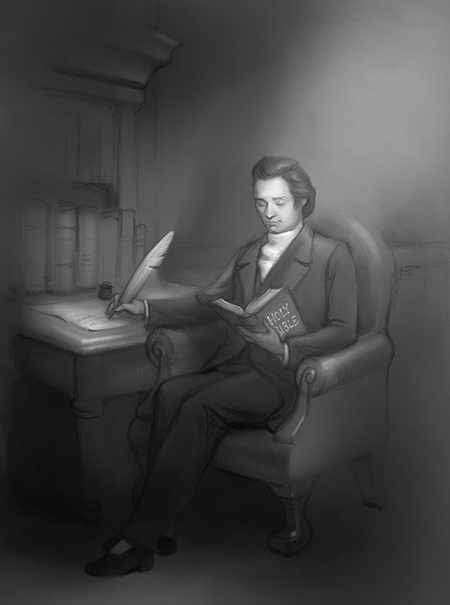
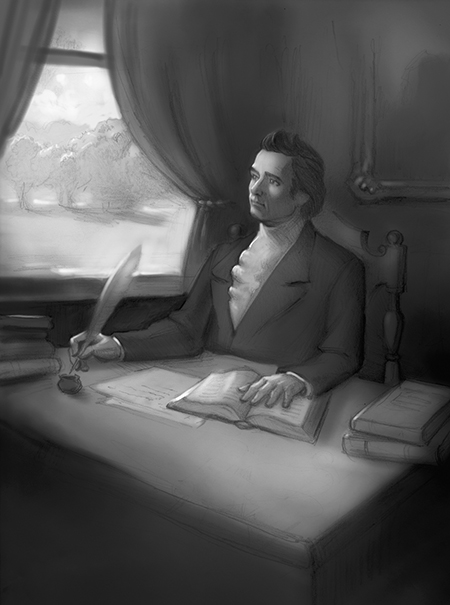
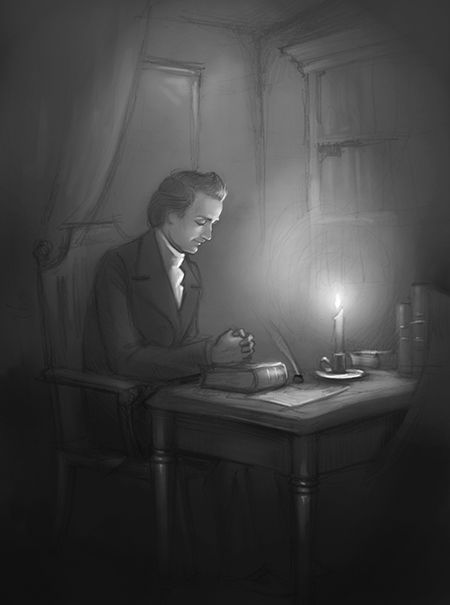
  • Below you will find three sketches from a talented artist and friend depicting Noah Webster at work. Please tell us what you think.
Divine Study
  • Divine StudyDivine Study
    Divine Study
Window of Reflection
  • Window of ReflectionWindow of Reflection
    Window of Reflection
Enlightening Grace
  • Enlightening GraceEnlightening Grace
    Enlightening Grace

160

939

116

1020

190

1057
Gaze

GAZE, verb intransitive [Gr. to be astonished, and Heb. to see or look, that is, to fix the eye or to reach with the eye.]

To fix the eyes and look steadily and earnestly; to look with eagerness or curiosity; as in admiration, astonishment, or in study.

A lover's eyes will gaze an eagle blind.

Ye men of Galilee, why stand ye gazing up into

heaven? Acts 1:1.

GAZE, verb transitive To view with fixed attention.

And gazed awhile the ample sky.

[It is little used as a transitive verb.]

GAZE, noun A fixed look; a look of eagerness, wonder or admiration; a continued look of attention.

With secret gaze

Or open admiration, him behold--

1. The object gazed on; that which causes one to gaze

Made of my enemies the scorn and gaze

Why 1828?

Word of the Day

importance

IMPORT'ANCE, n.

1. Weight; consequence; a bearing on some interest; that quality of any thing by which it may affect a measure, interest or result. The education of youth is of great importance to a free government. A religious education is of infinite importance to every human being.

2. Weight or consequence in the scale of being.

Thy own importance know.

Nor bound thy narrow views to things below.

3. Weight or consequence in self-estimation.

He believes himself a man of importance.

4. Thing implied; matter; subject; importunity. [In these senses, obsolete.]

Random Word

catch

CATCH, v.t.

1. To seize or lay hold on with the hand; carrying the sense of pursuit, thrusting forward the hand, or rushing on.

And they came upon him and caught him. Acts 6.

2. To seize, in a general sense; as, to catch a ball; to catch hold of a bough.

3. To seize, as in a snare or trap; to ensnare; to entangle.

They sent certain of the Pharisees and of the Herodians, to catch him in his words. Mark 12.

4. To seize in pursuit; hence simply to overtake; a popular use of the word.

He ran, but could not catch him companion.

5. To take hold; to communicate to.

The fire caught the adjoining building.

6. To seize the affections; to engage and attach to; as, to catch the fair.

7. To take or receive by contagion or infection; as, to catch the measles or small pox.

8. To snatch; to take suddenly; as, to catch a book out of the hand.

9. To receive something passing.

The swelling sails no more catch the soft airs and wanton in the sky. Trumbull.

To catch at, to endeavor to seize suddenly.

To catch at all opportunities of subverting the state.

To catch up, to snatch; to take up suddenly.

CATCH, v.i.

1. To communicate; to spread by infecting; as, a disease will catch from man to man.

2. Any thing that seizes or takes hold, as a hook.

3. The posture of seizing; a state of preparation to catch, or of watching an opportunity to seize; as, to lie upon the catch.

4. A sudden advantage taken.

5. The thing caught, considered as an object of desire; profit; advantage.

Hector shall have a great catch. Shak.

6. A snatch; a short interval of action.

It has been writ by catches.

7. A little portion.

We retain a catch of a pretty story.

8. In music, a fugue in the unison, wherein to humor some conceit in the words, the melody is broken, and the sense is interrupted in one part, and caught and supported by another, or a different sense is given to the words; or a piece for three or more voices, one of which leads and the others follow in the same notes.

Noah's 1828 Dictionary

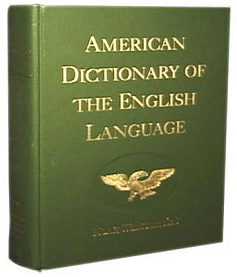
First dictionary of the American Language!

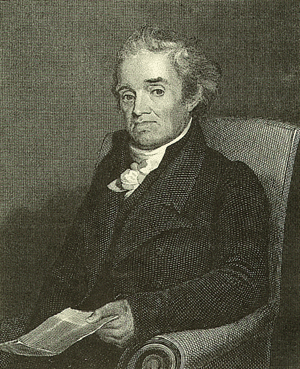
Noah Webster, the Father of American Christian education, wrote the first American dictionary and established a system of rules to govern spelling, grammar, and reading. This master linguist understood the power of words, their definitions, and the need for precise word usage in communication to maintain independence. Webster used the Bible as the foundation for his definitions.

This standard reference tool will greatly assist students of all ages in their studies.

No other dictionary compares with the Webster's 1828 dictionary. The English language has changed again and again and in many instances has become corrupt. The American Dictionary of the English Language is based upon God's written word, for Noah Webster used the Bible as the foundation for his definitions. This standard reference tool will greatly assist students of all ages in their studies. From American History to literature, from science to the Word of God, this dictionary is a necessity. For homeschoolers as well as avid Bible students it is easy, fast, and sophisticated.


Regards,


monte

{x:

Project:: 1828 Reprint


Hard-cover Edition

372

550

Compact Edition

357

249

CD-ROM

307

195

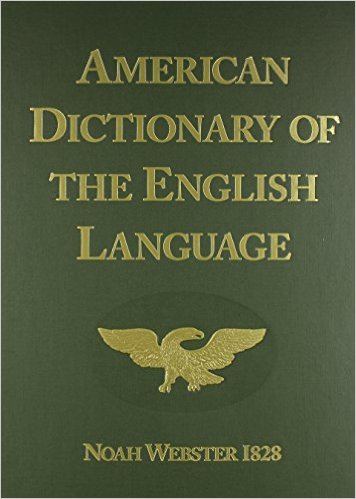
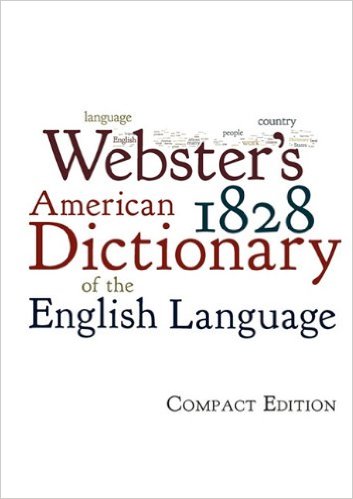
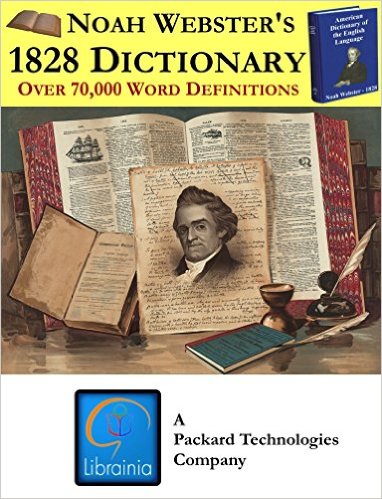
* As a note, I have purchased each of these products. In fact, as we have been developing the Project:: 1828 Reprint, I have purchased several of the bulky hard-cover dictionaries. My opinion is that the 2000-page hard-cover edition is the only good viable solution at this time. The compact edition was a bit disappointing and the CD-ROM as well.


[ + ]
Add Search To Your Site


Our goal is to convert the facsimile dictionary (PDF available: v1 and v2) to reprint it and make it digitally available in several formats.

Overview of Project

  1. Image dissection
  2. Text Emulation
  3. Dictionary Formatting
  4. Digital Applications
  5. Reprint

Please visit our friends:

{ourFriends}

Learn more about U.S. patents:

{ourPatent}

Privacy Policy

We want to provide the best 1828 dictionary service to you. As such, we collect data, allow you to login, and we want your feedback on other features you would like.

For details of our terms of use, please read our privacy policy here.

Page loaded in 2.095 seconds. [1828: 22, T:0]


1828 Noah Webster Dictionary

^ return to top
Back to Top