|
Search, browse, and study this dictionary to learn more about the early American, Christian language. 
1828.mshaffer.com › Word [principle]
PRIN'CIPLE, n. [L. principium, beginning.] 1. In a general sense, the cause, source or origin of any thing; that from which a thing proceeds; as the principle of motion; the principles of action.2. Element; constituent part; primordial substance. Modern philosophers suppose matter to be one simple principle, or solid extension diversified by its various shapes.3. Being that produces any thing; operative cause. The soul of man is an active principle.4. In science, a truth admitted either without proof, or considered as having been before proved. In the former sense, it is synonymous with axiom; in the latter, with the phrase, established principle.5. Ground; foundation; that which supports an assertion, an action, or a series of actions or of reasoning. On what principle can this be affirmed or denied? He justifies his proceedings on the principle of expedience or necessity. He reasons on sound principles.6. A general truth; a law comprehending many subordinate truths; as the principles of morality, of law, of government, &c.7. Tenet; that which is believed, whether truth or not, but which serves as a rule of action or the basis of a system; as the principles of the Stoics, or of the Epicureans.8. A principle of human nature, is a law of action in human beings; a constitutional propensity common to the human species. Thus it is a principle of human nature to resent injuries and repel insults.PRIN'CIPLE, v.t. To establish or fix in tenets; to impress with any tenet, good or ill; chiefly used in the participle. Men have been principled with an opinion, that they must not consult reason in things of religion.1. To establish firmly in the mind.
|
Evolution (or devolution) of this word [principle]
| 1828 Webster | 1844 Webster | 1913 Webster |
|---|
PRIN'CIPLE, n. [L. principium, beginning.] 1. In a general sense, the cause, source or origin of any thing; that from which a thing proceeds; as the principle of motion; the principles of action.2. Element; constituent part; primordial substance. Modern philosophers suppose matter to be one simple principle, or solid extension diversified by its various shapes.3. Being that produces any thing; operative cause. The soul of man is an active principle.4. In science, a truth admitted either without proof, or considered as having been before proved. In the former sense, it is synonymous with axiom; in the latter, with the phrase, established principle.5. Ground; foundation; that which supports an assertion, an action, or a series of actions or of reasoning. On what principle can this be affirmed or denied? He justifies his proceedings on the principle of expedience or necessity. He reasons on sound principles.6. A general truth; a law comprehending many subordinate truths; as the principles of morality, of law, of government, &c.7. Tenet; that which is believed, whether truth or not, but which serves as a rule of action or the basis of a system; as the principles of the Stoics, or of the Epicureans.8. A principle of human nature, is a law of action in human beings; a constitutional propensity common to the human species. Thus it is a principle of human nature to resent injuries and repel insults.PRIN'CIPLE, v.t. To establish or fix in tenets; to impress with any tenet, good or ill; chiefly used in the participle. Men have been principled with an opinion, that they must not consult reason in things of religion.1. To establish firmly in the mind. |
PRIN'CI-PLE, n. [It. principio; Fr. principe; L. principium, beginning.]- In a general sense, the cause, source or origin of any thing; that from which a thing proceeds; as, the principle of motion; the principles of action. – Dryden.
- Element; constituent part; primordial substance.
Modern philosophers suppose matter to be one simple principle, or solid extension diversified by its various shapes. – Watts.
- Being that produces any thing; operative cause.
The soul of man is an active principle. – Tillotson.
- In science, a truth admitted either without proof, or considered as having been before proved. In the former sense it is synonymous with axiom; in the latter, with the phrase, established principle.
- Ground; foundation; that which supports an assertion, an action, or a series of actions or of reasoning. On what principle can this be affirmed or denied? He justifies his proceedings on the principle of expedience or necessity. He reasons on sound principles.
- A general truth; a law comprehending many subordinate truths; as, the principles of morality, of law, of government, &c.
- Tenet; that which is believed, whether truth or not, but which serves as a rule of action or the basis of a system, the principles of the Stoics, or of the Epicureans.
- A principle of human nature, is a law of action in human beings; a constitutional propensity common to the human species. Thus it is a principle of human nature to resent injuries and repel insults.
PRIN'CI-PLE, v.t.- To establish or fix in tenets; to impress with any tenet, good or ill; chiefly used in the participle.
Men have been principled with an opinion, that they must not consult reason an things of religion. – Locke.
- To establish firmly in the mind. – Locke.
|
Prin"ci*ple
- Beginning;
commencement.
- To equip with principles]
to establish, or fix, in certain principles; to impress with any
tenet, or rule of conduct, good or ill.
- A source, or origin; that from which
anything proceeds; fundamental substance or energy; primordial
substance; ultimate element, or cause.
- An original faculty or endowment.
- A fundamental truth; a comprehensive law or
doctrine, from which others are derived, or on which others are
founded; a general truth; an elementary proposition; a maxim; an
axiom; a postulate.
- A settled rule of action; a governing law
of conduct; an opinion or belief which exercises a directing influence
on the life and behavior; a rule (usually, a right rule) of conduct
consistently directing one's actions; as, a person of no
principle.
- Any original inherent
constituent which characterizes a substance, or gives it its essential
properties, and which can usually be separated by analysis; -- applied
especially to drugs, plant extracts, etc.
|
| 1828 Webster | 1844 Webster | 1913 Webster |
|---|
Thank you for visiting!
- Our goal is to try and improve the quality of the digital form of this dictionary being historically true and accurate to the first American dictionary. Read more ...
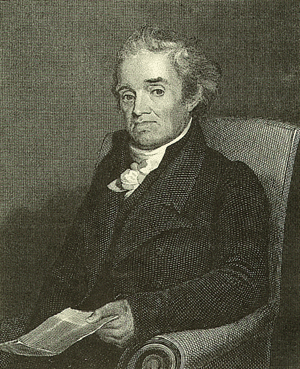
- Below you will find three sketches from a talented artist and friend depicting Noah Webster at work. Please tell us what you think.
Divine Study
 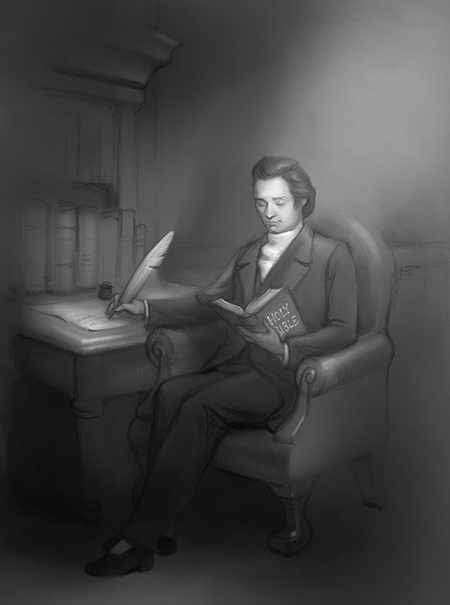
Divine Study
|
Window of Reflection
 
Window of Reflection
|
Enlightening Grace
 
Enlightening Grace
|
164
|
947 |
123
|
1030 |
197
|
1063 |

Principle PRIN'CIPLE, noun [Latin principium, beginning.] 1. In a general sense, the cause, source or origin of any thing; that from which a thing proceeds; as the principle of motion; the principles of action. 2. Element; constituent part; primordial substance. Modern philosophers suppose matter to be one simple principle or solid extension diversified by its various shapes. 3. Being that produces any thing; operative cause. The soul of man is an active principle 4. In science, a truth admitted either without proof, or considered as having been before proved. In the former sense, it is synonymous with axiom; in the latter, with the phrase, established principle 5. Ground; foundation; that which supports an assertion, an action, or a series of actions or of reasoning. On what principle can this be affirmed or denied? He justifies his proceedings on the principle of expedience or necessity. He reasons on sound principles. 6. A general truth; a law comprehending many subordinate truths; as the principles of morality, of law, of government, etc. 7. Tenet; that which is believed, whether truth or not, but which serves as a rule of action or the basis of a system; as the principles of the Stoics, or of the Epicureans. 8. A principle of human nature, is a law of action in human beings; a constitutional propensity common to the human species. Thus it is a principle of human nature to resent injuries and repel insults. PRIN'CIPLE, verb transitive To establish or fix in tenets; to impress with any tenet, good or ill; chiefly used in the participle. Men have been principled with an opinion, that they must not consult reason in things of religion. 1. To establish firmly in the mind. |

|
| Hard-cover Edition |
379 |
 |
559 |
|
| Compact Edition |
365 |
 |
254 |
|
| CD-ROM |
319 |
 |
200 |
|
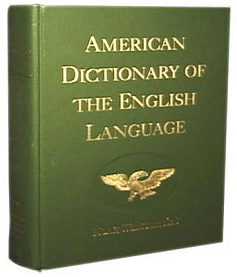
* As a note, I have purchased each of these products. In fact, as we have been developing the Project:: 1828 Reprint, I have purchased several of the bulky hard-cover dictionaries. My opinion is that the 2000-page hard-cover edition is the only good viable solution at this time. The compact edition was a bit disappointing and the CD-ROM as well. |
| [ + ] |
| Add Search To Your Site |
|
|
|