HOME
SIGN UP LOGIN
https://1828.mshaffer.com
Wednesday - October 21, 2026
↓

In my view, the Christian religion is the most important and one of the first things in which all children, under a free government ought to be instructed... No truth is more evident to my mind than that the Christian religion must be the basis of any government intended to secure the rights and privileges of a free people.
- Preface

1828 Noah Webster Dictionary
  A B C D E F G H I J K L M N O P Q R S T U V W X Y Z   <3

Search, browse, and study this dictionary to learn more about the early American, Christian language.

1828.mshaffer.com › Word [main]

0
0
Cite this! Share Definition on Facebook Share Definition on Twitter Simple Definition Word-definition Evolution

main

MAIN, a. [L. magnus.]

1. Principal; chief; that which has most power in producing an effect, or which is mostly regarded in prospect; as the main branch or tributary stream of a river; the main timbers of an edifice; a main design; a main object.

Our main interest is to be as happy as we can, and as long as possible.

2. Mighty; vast; as the main abyss.

3. Important; powerful.

This young prince, with a train of young noblemen and gentlemen, not with any main army, came over to take possession of his patrimony.

MAIN, n. Strength; force; violent effort; as in the phrase, "with might and main."

1. The gross; the bulk; the greater part.

The main of them may be reduced to language and an improvement in wisdom--

2. The ocean; the great sea, as distinguished from rivers, bays, sounds and the like.

He fell, and struggling in the main--

3. The continent, as distinguished from an isle. We arrived at Nantucket on Saturday, but did not reach the main till Monday. In this use of the word, land is omitted; main for main land.

4. A hamper.

5. A course; a duct.

For the main, in the main, for the most part; in the greatest part.

MAIN, n. [L. manus, hand.] A hand at dice. We throw a merry main.

And lucky mains make people wise. [Not used.]

1. A match at cock fighting.


Evolution (or devolution) of this word [main]

1828 Webster1844 Webster1913 Webster

MAIN, a. [L. magnus.]

1. Principal; chief; that which has most power in producing an effect, or which is mostly regarded in prospect; as the main branch or tributary stream of a river; the main timbers of an edifice; a main design; a main object.

Our main interest is to be as happy as we can, and as long as possible.

2. Mighty; vast; as the main abyss.

3. Important; powerful.

This young prince, with a train of young noblemen and gentlemen, not with any main army, came over to take possession of his patrimony.

MAIN, n. Strength; force; violent effort; as in the phrase, "with might and main."

1. The gross; the bulk; the greater part.

The main of them may be reduced to language and an improvement in wisdom--

2. The ocean; the great sea, as distinguished from rivers, bays, sounds and the like.

He fell, and struggling in the main--

3. The continent, as distinguished from an isle. We arrived at Nantucket on Saturday, but did not reach the main till Monday. In this use of the word, land is omitted; main for main land.

4. A hamper.

5. A course; a duct.

For the main, in the main, for the most part; in the greatest part.

MAIN, n. [L. manus, hand.] A hand at dice. We throw a merry main.

And lucky mains make people wise. [Not used.]

1. A match at cock fighting.

MAIN, a. [Sax. mægn, strength, force, power, from magan, to be able or strong, that is, to strain or stretch, Eng. may, might. If g is radical in the L. magnus, this may be of the same family; Goth. mickels; Eng. much.]

  1. Principal; chief; that which has most power in producing an effect, or which is mostly regarded in prospect; as, the main branch or tributary stream of a river; the main timbers of an edifice; a main design; a main object. Our main interest is to be as happy as we can, and as long as possible. Tillotson.
  2. Mighty; vast; as, the main abyss. Milton.
  3. Important; powerful. This young prince, with a train of young noblemen and gentlemen, not with any main army, came over to take possession of his patrimony. Davies.

MAIN, n.1

  1. Strength; force; violent effort; as in the phrase, “with might and main.” Dryden.
  2. The gross; the bulk; the greater part. The main of them may be reduced to language and an improvement in wisdom. Locke.
  3. The ocean; the great sea, as distinguished from rivers, bays, sounds and the like. He fell, and struggling in the main. Dryden.
  4. The continent, as distinguished from an isle. We arrived at Nantucket on Saturday, but did not reach the main till Monday. In this use of the word, land is omitted; main for main land.
  5. A hamper. Ainsworth.
  6. A course; a duct. Act of Parliament. For the main, in the main, for the most part; in the greatest part.

MAIN, n.2 [L. manus, hand; Fr. main.]

  1. A hand at dice. We throw a merry main. And lucky mains make people wise. [Not used.] Prior.
  2. A match at cock-fighting.

Main
  1. A hand or match at dice.

    Prior. Thackeray.
  2. Strength; force; might; violent effort.

    [Obs., except in certain phrases.]

    There were in this battle of most might and main. R. of Gl.

    He 'gan advance,
    With huge force, and with importable main.
    Spenser.

  3. Very or extremely strong.

    [Obs.]

    That current with main fury ran. Daniel.

  4. Very; extremely; as, main heavy.

    "I'm main dry." Foote. [Obs. or Low]
  5. A stake played for at dice.

    [Obs.] Shak.
  6. The chief or principal part; the main or most important thing.

    [Obs., except in special uses.]

    Resolved to rest upon the title of Lancaster as the main, and to use the other two . . . but as supporters. Bacon.

  7. Vast; huge.

    [Obs.] "The main abyss." Milton.
  8. The largest throw in a match at dice; a throw at dice within given limits, as in the game of hazard.
  9. The great sea, as distinguished from an arm, bay, etc. ; the high sea; the ocean.

    "Struggling in the main." Dryden. (b)
  10. Unqualified; absolute; entire; sheer.

    [Obs.] "It's a man untruth." Sir W. Scott.
  11. A match at cockfighting.

    "My lord would ride twenty miles . . . to see a main fought." Thackeray.
  12. Principal; chief; first in size, rank, importance, etc.

    Our main interest is to be happy as we can. Tillotson.

  13. A main-hamper.

    [Obs.] Ainsworth.
  14. Important; necessary.

    [Obs.]

    That which thou aright
    Believest so main to our success, I bring.
    Milton.

    By main force, by mere force or sheer force; by violent effort; as, to subdue insurrection by main force.

    That Maine which by main force Warwick did win. Shak.

    -- By main strength, by sheer strength; as, to lift a heavy weight by main strength. -- Main beam (Steam Engine), working beam. -- Main boom (Naut.), the boom which extends the foot of the mainsail in a fore and aft vessel. -- Main brace. (a) (Mech.) The brace which resists the chief strain. Cf. Counter brace. (b) (Naut.) The brace attached to the main yard. -- Main center (Steam Engine), a shaft upon which a working beam or side lever swings. -- Main chance. See under Chance. -- Main couple (Arch.), the principal truss in a roof. -- Main deck (Naut.), the deck next below the spar deck; the principal deck. -- Main keel (Naut.), the principal or true keel of a vessel, as distinguished from the false keel.

    Syn. -- Principal; chief; leading; cardinal; capital.

1828 Webster1844 Webster1913 Webster

Thank you for visiting!

  • Our goal is to try and improve the quality of the digital form of this dictionary being historically true and accurate to the first American dictionary. Read more ...
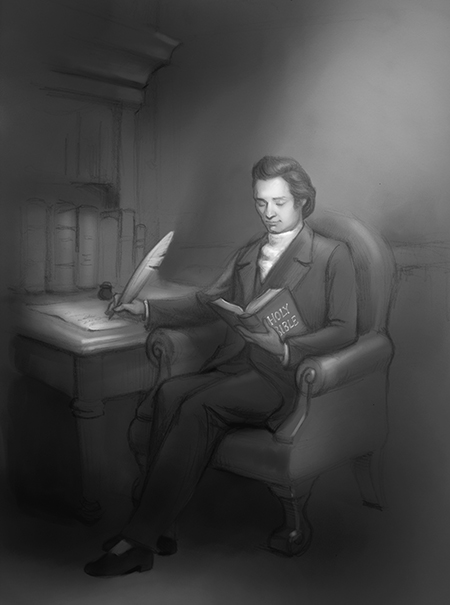
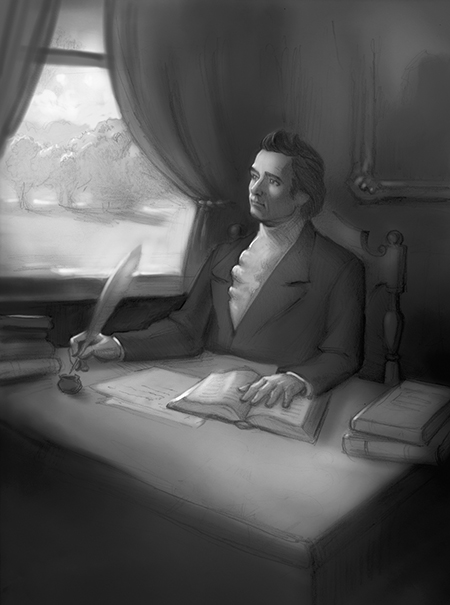
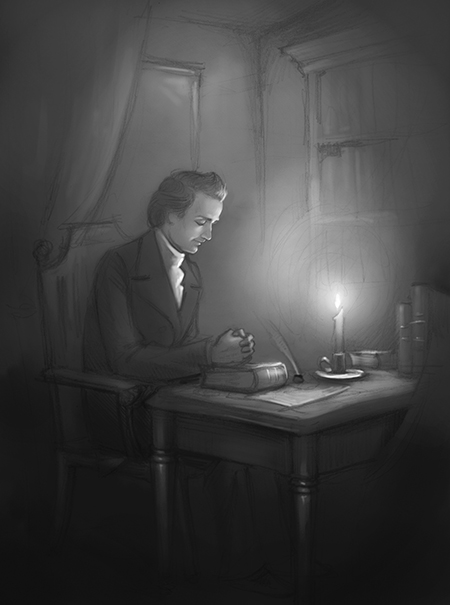
  • Below you will find three sketches from a talented artist and friend depicting Noah Webster at work. Please tell us what you think.
Divine Study
  • Divine StudyDivine Study
    Divine Study
Window of Reflection
  • Window of ReflectionWindow of Reflection
    Window of Reflection
Enlightening Grace
  • Enlightening GraceEnlightening Grace
    Enlightening Grace

164

955

126

1037

199

1078
Main

MAIN, adjective [Latin magnus.]

1. Principal; chief; that which has most power in producing an effect, or which is mostly regarded in prospect; as the main branch or tributary stream of a river; the main timbers of an edifice; a main design; a main object.

Our main interest is to be as happy as we can, and as long as possible.

2. Mighty; vast; as the main abyss.

3. Important; powerful.

This young prince, with a train of young noblemen and gentlemen, not with any main army, came over to take possession of his patrimony.

MAIN, noun Strength; force; violent effort; as in the phrase, 'with might and main '

1. The gross; the bulk; the greater part.

The main of them may be reduced to language and an improvement in wisdom--

2. The ocean; the great sea, as distinguished from rivers, bays, sounds and the like.

He fell, and struggling in the main--

3. The continent, as distinguished from an isle. We arrived at Nantucket on Saturday, but did not reach the main till Monday. In this use of the word, land is omitted; main for main land.

4. A hamper.

5. A course; a duct.

For the main in the main for the most part; in the greatest part.

MAIN, noun [Latin manus, hand.] A hand at dice. We throw a merry main

And lucky mains make people wise. [Not used.]

1. A match at cock fighting.

Why 1828?

Word of the Day

importance

IMPORT'ANCE, n.

1. Weight; consequence; a bearing on some interest; that quality of any thing by which it may affect a measure, interest or result. The education of youth is of great importance to a free government. A religious education is of infinite importance to every human being.

2. Weight or consequence in the scale of being.

Thy own importance know.

Nor bound thy narrow views to things below.

3. Weight or consequence in self-estimation.

He believes himself a man of importance.

4. Thing implied; matter; subject; importunity. [In these senses, obsolete.]

Random Word

fly

FLY, v.i.

1. To move through air by the aid of wings, as fowls.

2. To pass or move in air, by the force of wind or other impulse; as, clouds and vapors fly before the wind. A ball flies from a cannon, an arrow from a bow.

3. To rise in air, as light substances, by means of a current of air or by having less specific gravity than air, as smoke.

Man is born to trouble, as the sparks fly upward. Job. 5.

4. To move or pass with velocity or celerity, either on land or water. He flew to the relief of his distressed friend. The ship flies upon the main.

5. To move rapidly, in any manner; as, a top flies about.

6. To pass away; to depart; with the idea of haste, swiftness or escape. The bird has flown.

7. To pass rapidly, as time. Swift fly the fleeting hours.

8. To part suddenly or with violence; to burst, as a bottle.

9. To spring by an elastic force.

10. To pass swiftly, as rumor or report.

11. To flee; to run away; to attempt to escape; to escape.

I'll fly from shepherds, flocks, and flowery plains.

12. To flutter; to vibrate or play; as a flag in the wind.

To fly at, to spring towards; to rush on; to fall on suddenly. A hen flies at a dog or cat; a dog flies at a man.

1. To fly in the face, to insult.

2. To assail; to resist; to set at defiance; to oppose with violence; to act in direct opposition.

1. To fly off, to separate or depart suddenly.

2. To revolt.

To fly open, to open suddenly or with violence; as, the doors flew open.

1. To fly out, to rush out; also, to burst into a passion.

2. To break out into license.

3. To start or issue with violence from any direction.

1. To let fly, to discharge; to throw or drive with violence; as, to let fly a shower of darts.

2. In seamanship, to let go suddenly. Let fly the sheets.

FLY, v.t. [This is used for flee, and from is understood after fly, so that it can hardly be called a transitive verb.]

1. To shun; to avoid; to decline; as, to fly the sight of one we hate. That is, primarily, to flee from

Sleep flies the wretch.

2. To quit by flight.

3. To attack by a bird of prey. [Not used.]

4. To cause to float in the air.

FLY, n.

1. In zoology, a winged insect of various species, whose distinguishing characteristic is that the wings are transparent. By this flies are distinguished from beetles, butterflies, grasshoppers, &c. Of flies, some have two wings and others four.

In common language, fly is the house fly, of the genus Musca.

2. In mechanics, a cross with leaden weights at the ends, or a heavy wheel at right angles with the axis of a windlass, jack or the like. The use of this is, to regulate and equalize the motion in all parts of the revolution of the machine.

3. That part of a vane which points and shows which way the wind blows.

4. The extent of an ensign, flag or pendant from the staff to the end that flutters loose in the wind.

Noah's 1828 Dictionary

First dictionary of the American Language!

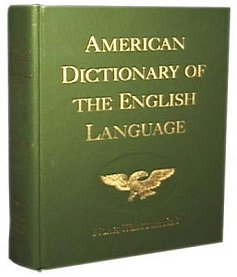
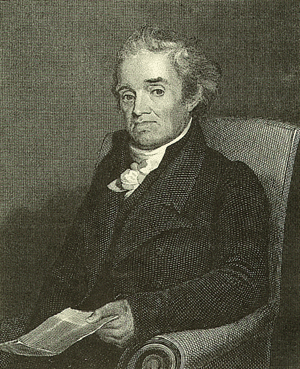
Noah Webster, the Father of American Christian education, wrote the first American dictionary and established a system of rules to govern spelling, grammar, and reading. This master linguist understood the power of words, their definitions, and the need for precise word usage in communication to maintain independence. Webster used the Bible as the foundation for his definitions.

This standard reference tool will greatly assist students of all ages in their studies.

No other dictionary compares with the Webster's 1828 dictionary. The English language has changed again and again and in many instances has become corrupt. The American Dictionary of the English Language is based upon God's written word, for Noah Webster used the Bible as the foundation for his definitions. This standard reference tool will greatly assist students of all ages in their studies. From American History to literature, from science to the Word of God, this dictionary is a necessity. For homeschoolers as well as avid Bible students it is easy, fast, and sophisticated.


Regards,


monte

{x:

Project:: 1828 Reprint


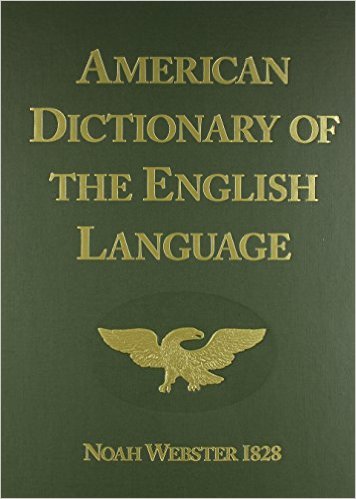
Hard-cover Edition

385

566

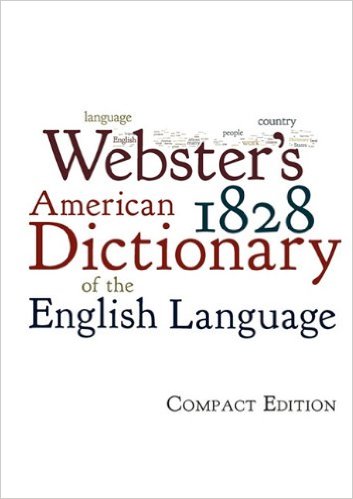
Compact Edition

369

259

CD-ROM

326

202

* As a note, I have purchased each of these products. In fact, as we have been developing the Project:: 1828 Reprint, I have purchased several of the bulky hard-cover dictionaries. My opinion is that the 2000-page hard-cover edition is the only good viable solution at this time. The compact edition was a bit disappointing and the CD-ROM as well.


[ + ]
Add Search To Your Site


Our goal is to convert the facsimile dictionary (PDF available: v1 and v2) to reprint it and make it digitally available in several formats.

Overview of Project

  1. Image dissection
  2. Text Emulation
  3. Dictionary Formatting
  4. Digital Applications
  5. Reprint

Please visit our friends:

{ourFriends}

Learn more about U.S. patents:

{ourPatent}

Privacy Policy

We want to provide the best 1828 dictionary service to you. As such, we collect data, allow you to login, and we want your feedback on other features you would like.

For details of our terms of use, please read our privacy policy here.

Page loaded in 0.37 seconds. [1828: 22, T:0]


1828 Noah Webster Dictionary

^ return to top
Back to Top