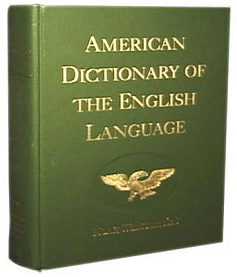
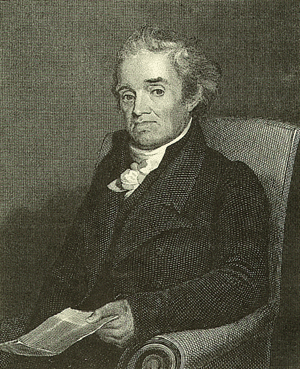
|
Search, browse, and study this dictionary to learn more about the early American, Christian language. 
1828.mshaffer.com › Word [give]
GIVE, v.t. pret. gave; pp. given. [Heb. to give. The sense of give is generally to pass, or to transfer, that is, to send or throw.] 1. To bestow; to confer; to pass or transfer the title or property of a thing to another person without an equivalent or compensation. For generous lords had rather give than pay.2. To transmit from himself to another by hand, speech or writing; to deliver. The woman whom thou gavest to be with me, she gave me of the tree, and I did eat. Gen.3.3. To import; to bestow. Give us of your oil, for our lamps are gone out. Matt.25.4. To communicate; as, to give an opinion; to give counsel or advice; to give notice.5. To pass or deliver the property of a thing to another for an equivalent; to pay. We give the full value of all we purchase. A dollar is given for a day's labor. What shall a man give in exchange for this soul? Matt.16.6. To yield; to lend; in the phrase to give ear, which signifies to listen; to hear.7. To quit;in the phrase to give place, which signifies to withdraw, or retire to make room for another. 8. To confer; to grant. What wilt thou give me, seeing I go childless? Gen 15.9. To expose; to yield to the power of. Give to the wanton winds their flowing hair. 10. To grant; to allow; to permit. It is given me once again to behold my friend. 11. To afford; to supply; to furnish. Thou must give us also sacrifices and burnt offerings. Ex.10. 12. To empower; to license; to commission. Then give thy friend to shed the sacred wine.But this and similar phrases are probably elliptical; give for give power or license. So in the phrases,give me to understand, give me to know, give the flowers to blow, that is, to give power, to enable. 13. To pay or render; as, to give praise, applause or approbation. 14. To render; to pronounce; as, to give sentence or judgment; to give the word of command. 15. To utter; to vent; as, to give a shout. 16. To produce; to show; to exhibit as a product or result; as, the number of men divided by the number of ships, gives four hundred to each ship. 17. To cause to exist; to excite in another; as, to give offense or umbrage; to give pleasure. 18. To send forth; to emit; as, a stone gives sparks with steel. 19. To addict; to apply; to devote one's self, followed by the reciprocal pronoun. The soldiers give themselves to plunder. The passive participle is much used in this sense; as, the people are given to luxury and pleasure; the youth is given to study. Give thyself wholly to them. 1 Tim.4. 20. To resign; to yield up; often followed by up. Who say, I care not, those I give for lost. 21. To pledge; as, I give my word that the debt shall be paid. 22. To present for taking or acceptance; as, I give you my hand. 23. To allow or admit by way of supposition. To give away, to alienate the title or property of a thing; to make over to another; to transfer. Whatsoever we employ in charitable uses, during our lives, is given away from ourselves.To give back, to return; to restore. To give forth, to publish; to tell; to report publicly. To give the hand, to yield preeminence, as being subordinate or inferior. To give in, to allow by way of abatement or deduction from a claim; to yield what may be justly demanded. To give over, to leave; to quit; to cease; to abandon; as, to give over a pursuit. 1. To addict; to attach to; to abandon. When the Babylonians had given themselves over to all manner of vice.2. To despair of recovery; to believe to be lost, or past recovery. The physician had given over the patient, or given the patient over.3. To abandon.To give out, to utter publicly; to report; to proclaim; to publish. It was given out that parliament would assemble in November. 1. To issue; to send forth; to publish. The night was distinguished by the orders which he gave out to his army.2. To show; to exhibit in false appearance.3. To send out; to emit; as, a substance gives out steam or odors.To give up, to resign; to quit; to yield as hopeless; as, to give up a cause; to give up the argument. 1. To surrender; as, to give up a fortress to an enemy.2. To relinquish, to cede. In this treaty the Spaniards gave up Louisiana.3. To abandon; as, to give up all hope. They are given up to believe a lie.4. To deliver. And Joab gave up the sum of the number of the people to the king. 2 Sam. 24.To give one's self up, to despair of one's recovery; to conclude to be lost. 1. To resign or devote. Let us give ourselves wholly up to Christ in heart and desire.2. To addict; to abandon. He gave himself up to intemperance.To give way, to yield; to withdraw to make room for. Inferiors should give way to superiors. 1. To fail; to yield or force; to break or fall. The ice gave way and the horses were drowned. The scaffolding gave way. The wheels or axletree gave way.2. To recede; to make room for.3. In seamen's language, give way is an order to a boat's crew to row after ceasing, or to increase their exertions.GIVE, v.i. giv. To yield to pressure. The earth gives under the feet. 1. To begin to melt; to thaw; to grow soft, so as to yield to pressure.2. To move; to recede. Now back he gives,then rushes on amain.To give in, to be back; to give way. [Not in use.] To give into, to yield assent; to adopt. This consideration may induce a translator to give in to those general phrases.To give off, to cease; to forbear. [Little used. To give on, to rush; to fall on. [Not in use.] To give out, to publish; to proclaim. 1. To cease from exertion; to yield; applied to persons. He labored hard, but gave out at last.To give over, to cease; to act no more; to desert. It would be well for all authors, if they knew when to give over, and to desist from any further pursuits after fame.
|
Evolution (or devolution) of this word [give]
| 1828 Webster | 1844 Webster | 1913 Webster |
|---|
GIVE, v.t. pret. gave; pp. given. [Heb. to give. The sense of give is generally to pass, or to transfer, that is, to send or throw.] 1. To bestow; to confer; to pass or transfer the title or property of a thing to another person without an equivalent or compensation. For generous lords had rather give than pay.2. To transmit from himself to another by hand, speech or writing; to deliver. The woman whom thou gavest to be with me, she gave me of the tree, and I did eat. Gen.3.3. To import; to bestow. Give us of your oil, for our lamps are gone out. Matt.25.4. To communicate; as, to give an opinion; to give counsel or advice; to give notice.5. To pass or deliver the property of a thing to another for an equivalent; to pay. We give the full value of all we purchase. A dollar is given for a day's labor. What shall a man give in exchange for this soul? Matt.16.6. To yield; to lend; in the phrase to give ear, which signifies to listen; to hear.7. To quit;in the phrase to give place, which signifies to withdraw, or retire to make room for another. 8. To confer; to grant. What wilt thou give me, seeing I go childless? Gen 15.9. To expose; to yield to the power of. Give to the wanton winds their flowing hair. 10. To grant; to allow; to permit. It is given me once again to behold my friend. 11. To afford; to supply; to furnish. Thou must give us also sacrifices and burnt offerings. Ex.10. 12. To empower; to license; to commission. Then give thy friend to shed the sacred wine.But this and similar phrases are probably elliptical; give for give power or license. So in the phrases,give me to understand, give me to know, give the flowers to blow, that is, to give power, to enable. 13. To pay or render; as, to give praise, applause or approbation. 14. To render; to pronounce; as, to give sentence or judgment; to give the word of command. 15. To utter; to vent; as, to give a shout. 16. To produce; to show; to exhibit as a product or result; as, the number of men divided by the number of ships, gives four hundred to each ship. 17. To cause to exist; to excite in another; as, to give offense or umbrage; to give pleasure. 18. To send forth; to emit; as, a stone gives sparks with steel. 19. To addict; to apply; to devote one's self, followed by the reciprocal pronoun. The soldiers give themselves to plunder. The passive participle is much used in this sense; as, the people are given to luxury and pleasure; the youth is given to study. Give thyself wholly to them. 1 Tim.4. 20. To resign; to yield up; often followed by up. Who say, I care not, those I give for lost. 21. To pledge; as, I give my word that the debt shall be paid. 22. To present for taking or acceptance; as, I give you my hand. 23. To allow or admit by way of supposition. To give away, to alienate the title or property of a thing; to make over to another; to transfer. Whatsoever we employ in charitable uses, during our lives, is given away from ourselves.To give back, to return; to restore. To give forth, to publish; to tell; to report publicly. To give the hand, to yield preeminence, as being subordinate or inferior. To give in, to allow by way of abatement or deduction from a claim; to yield what may be justly demanded. To give over, to leave; to quit; to cease; to abandon; as, to give over a pursuit. 1. To addict; to attach to; to abandon. When the Babylonians had given themselves over to all manner of vice.2. To despair of recovery; to believe to be lost, or past recovery. The physician had given over the patient, or given the patient over.3. To abandon.To give out, to utter publicly; to report; to proclaim; to publish. It was given out that parliament would assemble in November. 1. To issue; to send forth; to publish. The night was distinguished by the orders which he gave out to his army.2. To show; to exhibit in false appearance.3. To send out; to emit; as, a substance gives out steam or odors.To give up, to resign; to quit; to yield as hopeless; as, to give up a cause; to give up the argument. 1. To surrender; as, to give up a fortress to an enemy.2. To relinquish, to cede. In this treaty the Spaniards gave up Louisiana.3. To abandon; as, to give up all hope. They are given up to believe a lie.4. To deliver. And Joab gave up the sum of the number of the people to the king. 2 Sam. 24.To give one's self up, to despair of one's recovery; to conclude to be lost. 1. To resign or devote. Let us give ourselves wholly up to Christ in heart and desire.2. To addict; to abandon. He gave himself up to intemperance.To give way, to yield; to withdraw to make room for. Inferiors should give way to superiors. 1. To fail; to yield or force; to break or fall. The ice gave way and the horses were drowned. The scaffolding gave way. The wheels or axletree gave way.2. To recede; to make room for.3. In seamen's language, give way is an order to a boat's crew to row after ceasing, or to increase their exertions.GIVE, v.i. giv. To yield to pressure. The earth gives under the feet. 1. To begin to melt; to thaw; to grow soft, so as to yield to pressure.2. To move; to recede. Now back he gives,then rushes on amain.To give in, to be back; to give way. [Not in use.] To give into, to yield assent; to adopt. This consideration may induce a translator to give in to those general phrases.To give off, to cease; to forbear. [Little used. To give on, to rush; to fall on. [Not in use.] To give out, to publish; to proclaim. 1. To cease from exertion; to yield; applied to persons. He labored hard, but gave out at last.To give over, to cease; to act no more; to desert. It would be well for all authors, if they knew when to give over, and to desist from any further pursuits after fame. |
GIVE, v.i. [giv.]- To yield to pressure. The earth gives under the feet.
- To begin to melt; to thaw; to grow soft, so as to yield to pressure. Bacon.
- To move; to recede.
Now back he gives, then rushes on amain. Daniel's Civil War.
To give in, to go back; to give way. [Not in use.]
To give in to, to yield assent; to adopt.
This consideration may induce a translator to give in to those general phrases. Pope.
To give off, to cease; to forbear. [Little used.] Locke.
To give on, to rush; to fall on. [Not in use.]
To give out, to publish; to proclaim.
#2. To cease from exertion; to yield; applied to persons. He labored hard, but gave out at last.
To give over, to cease; to act no more; to desert.
It would be well for all authors, if they knew when to give over, and to desist from any further pursuits after fame. Addison.
GIVE, v.t. [giv; pret. gave; pp. given. [Sax. gifan, gyfan; Goth. giban; G. geben; D. geeven; Sw. gifva; Dan. giver. Hence, Sax. gif, Goth. iabai or yabai, now contracted into if. Chaucer wrote yeve, yave. Qu. Heb. Ch. Syr. and Sam. יהב, to give. See Class Gb, No. 3, 26, 43. The sense of give is generally to pass, or to transfer, that is, to send or throw.]- To bestow; to confer; to pass or transfer the title or property of a thing to another person without an equivalent or compensation.
For generous lords had rather give than pay. Young.
- To transmit from himself to another by hand, speech or writing; to deliver.
The woman whom thou gavest to be with me, she gave me of the tree, and I did eat. Gen. iii.
- To impart; to bestow.
Give us of your oil, for our lamps are gone out. Matth. xxv.
- To communicate; as, to give an opinion; to give counsel or advice; to give notice.
- To pass or deliver the property of a thing to another for an equivalent; to pay. We give the full value of all we purchase. A dollar is given for a day's labor.
What shall a man give in exchange for his soul? Matth. xvi.
- To yield; to lend; in the phrase to give ear, which signifies to listen; to hear.
- To quit; in the phrase to give place, which signifies to withdraw, or retire to make room for another.
- To confer; to grant.
What wilt thou give me, seeing I go childless? Gen. xv.
- To expose; to yield to the power of.
Give to the wanton winds their flowing hair. Dryden.
- To grant; to allow; to permit.
It is given me once again to behold my friend. Rowe.
- To afford; to supply; to furnish.
Thou must give us also sacrifices and burnt-offerings. Exod. x.
- To empower; to license; to commission.
Then give thy friend to shed the sacred wine. Pope.
But this and similar phrases are probably elliptical; give for give power or license. So in the phrases, give me to understand, give me to know, give the flowers to blow; that is, to give power, to enable.
- To pay or render; as, to give praise, applause or approbation.
- To render; to pronounce; as, to give sentence or judgment; to give the word of command.
- To utter; to vent; as, to give a shout.
- To produce; to show; to exhibit as a product or result; as, the number of men divided by the number of ships, gives four hundred to each ship.
- To cause to exist; to excite in another; as, to give offense or umbrage; to give pleasure.
- To send forth; to emit; as, a stone gives sparks with steel.
- To addict; to apply; to devote one's self, followed by the reciprocal pronoun. The soldiers give themselves to plunder. The passive participle is much used in this sense; as, the people are given to luxury and pleasure; the youth is given to study.
Give thyself wholly to them. 1 Tim. iv.
- To resign; to yield up; often followed by up.
Who say, I care not, those I give for lost. Herbert.
- To pledge; as, I give my word that the debt shall be paid.
- To present for taking or acceptance; as, I give you my hand.
- To allow or admit by way of supposition.
To give away, to alienate the title or property of a thing; to make over to another; to transfer.
Whatsoever we employ in charitable uses during our lives, is given away from ourselves. Atterbury.
To give back, to return; to restore. Atterbury.
To give forth, to publish; to tell; to report publicly. Hayward.
To give the hand, to yield preeminence, as being subordinate or inferior. Hooker.
To give in, to allow by way of abatement or deduction from a claim; to yield what may be justly demanded.
To give over, to leave; to quit; to cease; to abandon; as, to give over a pursuit.
#2. To addict; to attach to; to abandon.
When the Babylonians had given themselves over to all manner of vice. Grew.
#3. To despair of recovery; to believe to be lost or past recovery. The physician had given over the patient, or given the patient over. Addison.
#4. To abandon. Milton.
To give out, to utter publicly; to report; to proclaim; to publish. It was given out that parliament would assemble in November.
#2. To issue; to send forth; to publish.
The night was distinguished by the orders which he gave out to his army. Addison.
#3. To show; to exhibit in false appearance. Shak.
#4. To send out; to emit; as, a substance gives out steam or odors.
To give up, to resign; to quit; to yield as hopeless; as, to give up a cause; to give up the argument.
#2. To surrender; as, to give up a fortress to an enemy.
#3. To relinquish; to cede. In this treaty the Spaniards gave up Louisiana.
#4. To abandon; as, to give up all hope. They are given up to believe a lie.
#5. To deliver.
And Joab gave up the sum of the number of the people to the king. 2 Sam. xxiv.
To give one's self up, to despair of one's recovery; to conclude to be lost.
#2. To resign or devote.
Let us give ourselves wholly up to Christ in heart and desire. Taylor.
#3. To addict; to abandon. He gave himself up to intemperance.
To give way, to yield; to withdraw to make room for. Inferiors should give way to superiors.
#2. To fail; to yield to force; to break or fall. The ice gave way, and the horses were drowned. The scaffolding gave way. The wheels or axletree gave way.
#3. To recede; to make room for.
#4. In seamen's language, give way is an order to a boat's crew to row after ceasing, or to increase their exertions. Mar. Dict.
|
Give
- To bestow without receiving a return; to
confer without compensation; to impart, as a possession; to grant, as
authority or permission; to yield up or allow.
- To give a gift or gifts.
- To afford a view
of; as, his window gave the park.
- To yield possesion of; to deliver over, as
property, in exchange for something; to pay; as, we give the
value of what we buy.
- To yield to force or pressure; to relax;
to become less rigid; as, the earth gives under the
feet.
- To yield; to furnish; to produce; to emit;
as, flint and steel give sparks.
- To become soft or moist.
- To communicate or announce, as advice,
tidings, etc.; to pronounce; to render or utter, as an opinion, a
judgment, a sentence, a shout, etc.
- To move; to recede.
- To grant power or license to; to permit;
to allow; to license; to commission.
- To shed tears; to weep.
- To exhibit as a product or result; to
produce; to show; as, the number of men, divided by the number of
ships, gives four hundred to each ship.
- To have a misgiving.
- To devote; to apply; used reflexively, to
devote or apply one's self; as, the soldiers give themselves
to plunder; also in this sense used very frequently in the past
participle; as, the people are given to luxury and pleasure;
the youth is given to study.
- To open; to lead.
- To set forth as a
known quantity or a known relation, or as a premise from which to
reason] -- used principally in the passive form
given.
- To allow or admit by way of
supposition.
- To attribute; to assign; to
adjudge.
- To excite or cause to exist, as a
sensation; as, to give offense; to give pleasure or
pain.
- To pledge; as, to give one's
word.
- To cause; to make; -- with the
infinitive; as, to give one to understand, to know,
etc.
|
| 1828 Webster | 1844 Webster | 1913 Webster |
|---|
Thank you for visiting!
- Our goal is to try and improve the quality of the digital form of this dictionary being historically true and accurate to the first American dictionary. Read more ...
- Below you will find three sketches from a talented artist and friend depicting Noah Webster at work. Please tell us what you think.
Divine Study
 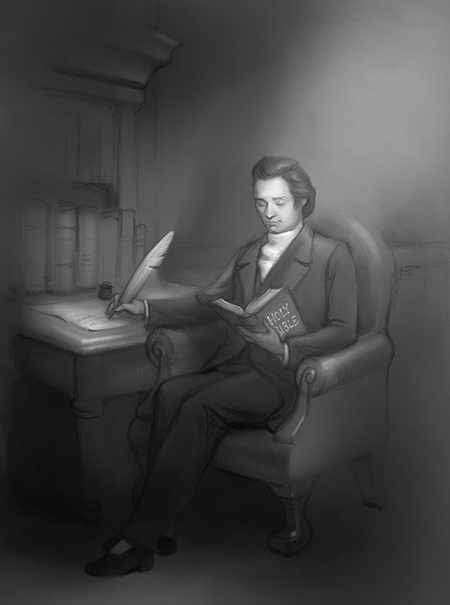
Divine Study
|
Window of Reflection
 
Window of Reflection
|
Enlightening Grace
 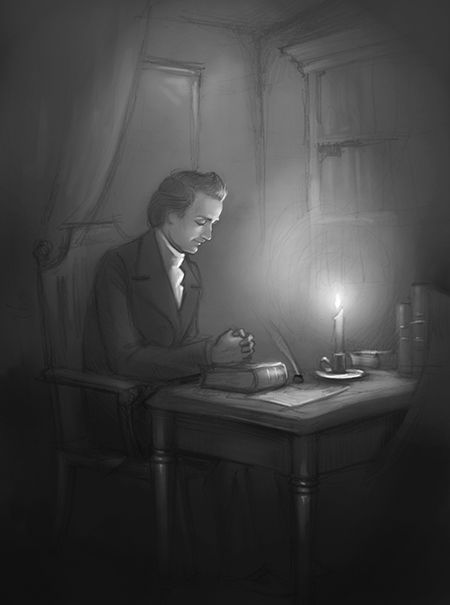
Enlightening Grace
|
164
|
953 |
126
|
1036 |
199
|
1076 |

Give GIVE, verb transitive preterit tense gave; participle passive given. [Heb. to give The sense of give is generally to pass, or to transfer, that is, to send or throw.] 1. To bestow; to confer; to pass or transfer the title or property of a thing to another person without an equivalent or compensation. For generous lords had rather give than pay. 2. To transmit from himself to another by hand, speech or writing; to deliver. The woman whom thou gavest to be with me, she gave me of the tree, and I did eat. Genesis 3:1. 3. To import; to bestow. GIVE us of your oil, for our lamps are gone out. Matthew 25:8. 4. To communicate; as, to give an opinion; to give counsel or advice; to give notice. 5. To pass or deliver the property of a thing to another for an equivalent; to pay. We give the full value of all we purchase. A dollar is given for a day's labor. What shall a man give in exchange for this soul? Matthew 16:19. 6. To yield; to lend; in the phrase to give ear, which signifies to listen; to hear. 7. To quit; in the phrase to give place, which signifies to withdraw, or retire to make room for another. 8. To confer; to grant. What wilt thou give me, seeing I go childless? Genesis 15:2. 9. To expose; to yield to the power of. GIVE to the wanton winds their flowing hair. 10. To grant; to allow; to permit. It is given me once again to behold my friend. 11. To afford; to supply; to furnish. Thou must give us also sacrifices and burnt offerings. Exodus 10:25. 12. To empower; to license; to commission. Then give thy friend to shed the sacred wine. But this and similar phrases are probably elliptical; give for give power or license. So in the phrases, give me to understand, give me to know, give the flowers to blow, that is, to give power, to enable. 13. To pay or render; as, to give praise, applause or approbation. 14. To render; to pronounce; as, to give sentence or judgment; to give the word of command. 15. To utter; to vent; as, to give a shout. 16. To produce; to show; to exhibit as a product or result; as, the number of men divided by the number of ships, gives four hundred to each ship. 17. To cause to exist; to excite in another; as, to give offense or umbrage; to give pleasure. 18. To send forth; to emit; as, a stone gives sparks with steel. 19. To addict; to apply; to devote one's self, followed by the reciprocal pronoun. The soldiers give themselves to plunder. The passive participle is much used in this sense; as, the people are given to luxury and pleasure; the youth is given to study. GIVE thyself wholly to them. 1 Timothy 4:13. 20. To resign; to yield up; often followed by up. Who say, I care not, those I give for lost. 21. To pledge; as, I give my word that the debt shall be paid. 22. To present for taking or acceptance; as, I give you my hand. 23. To allow or admit by way of supposition. To give away, to alienate the title or property of a thing; to make over to another; to transfer. Whatsoever we employ in charitable uses, during our lives, is given away from ourselves. To give back, to return; to restore. To give forth, to publish; to tell; to report publicly. To give the hand, to yield preeminence, as being subordinate or inferior. To give in, to allow by way of abatement or deduction from a claim; to yield what may be justly demanded. To give over, to leave; to quit; to cease; to abandon; as, to give over a pursuit. 1. To addict; to attach to; to abandon. When the Babylonians had given themselves over to all manner of vice. 2. To despair of recovery; to believe to be lost, or past recovery. The physician had given over the patient, or given the patient over. 3. To abandon. To give out, to utter publicly; to report; to proclaim; to publish. It was given out that parliament would assemble in November. 1. To issue; to send forth; to publish. The night was distinguished by the orders which he gave out to his army. 2. To show; to exhibit in false appearance. 3. To send out; to emit; as, a substance gives out steam or odors. To give up, to resign; to quit; to yield as hopeless; as, to give up a cause; to give up the argument. 1. To surrender; as, to give up a fortress to an enemy. 2. To relinquish, to cede. In this treaty the Spaniards gave up Louisiana. 3. To abandon; as, to give up all hope. They are given up to believe a lie. 4. To deliver. And Joab gave up the sum of the number of the people to the king. 2 Samuel 24:23. To give one's self up, to despair of one's recovery; to conclude to be lost. 1. To resign or devote. Let us give ourselves wholly up to Christ in heart and desire. 2. To addict; to abandon. He gave himself up to intemperance. To give way, to yield; to withdraw to make room for. Inferiors should give way to superiors. 1. To fail; to yield or force; to break or fall. The ice gave way and the horses were drowned. The scaffolding gave way. The wheels or axletree gave way. 2. To recede; to make room for. 3. In seamen's language, give way is an order to a boat's crew to row after ceasing, or to increase their exertions. GIVE, verb intransitive giv. To yield to pressure. The earth gives under the feet. 1. To begin to melt; to thaw; to grow soft, so as to yield to pressure. 2. To move; to recede. Now back he gives, then rushes on amain. To give in, to be back; to give way. [Not in use.] To give into, to yield assent; to adopt. This consideration may induce a translator to give in to those general phrases. To give off, to cease; to forbear. [Little used. To give on, to rush; to fall on. [Not in use.] To give out, to publish; to proclaim. 1. To cease from exertion; to yield; applied to persons. He labored hard, but gave out at last. To give over, to cease; to act no more; to desert. It would be well for all authors, if they knew when to give over, and to desist from any further pursuits after fame. |

|
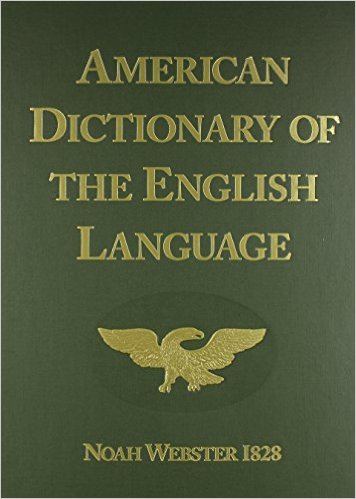
| Hard-cover Edition |
383 |
 |
564 |
|
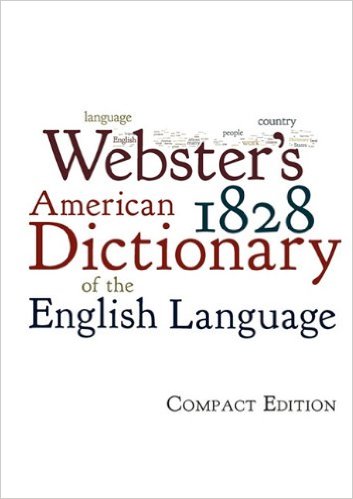
| Compact Edition |
369 |
 |
257 |
|
| CD-ROM |
325 |
 |
202 |
|
* As a note, I have purchased each of these products. In fact, as we have been developing the Project:: 1828 Reprint, I have purchased several of the bulky hard-cover dictionaries. My opinion is that the 2000-page hard-cover edition is the only good viable solution at this time. The compact edition was a bit disappointing and the CD-ROM as well. |
| [ + ] |
| Add Search To Your Site |
|
|
|