HOME
SIGN UP LOGIN
https://1828.mshaffer.com
Saturday - January 17, 2026

In my view, the Christian religion is the most important and one of the first things in which all children, under a free government ought to be instructed... No truth is more evident to my mind than that the Christian religion must be the basis of any government intended to secure the rights and privileges of a free people.
- Preface

1828 Noah Webster Dictionary
  A B C D E F G H I J K L M N O P Q R S T U V W X Y Z   <3

Search, browse, and study this dictionary to learn more about the early American, Christian language.

1828.mshaffer.comWord [explicit]

0
0
Cite this! Share Definition on Facebook Share Definition on Twitter Simple Definition Word-definition Evolution

explicit

EXPLIC'IT, a. [L. explicitus, part of explico, to unfold.]

1. Literally, unfolded. Hence, plain in language; open to the understanding; clear, not obscure or ambiguous; express, not merely implied. An explicit proposition or declaration is that in which the words, in their common acceptation, express the true meaning of the person who utters them, and in which there is no ambiguity or disguise.

2. Plain; open; clear; unreserved; having no disguised meaning or reservation; applied to persons. He was explicit in his terms.


Evolution (or devolution) of this word [explicit]

1828 Webster1844 Webster1913 Webster

EXPLIC'IT, a. [L. explicitus, part of explico, to unfold.]

1. Literally, unfolded. Hence, plain in language; open to the understanding; clear, not obscure or ambiguous; express, not merely implied. An explicit proposition or declaration is that in which the words, in their common acceptation, express the true meaning of the person who utters them, and in which there is no ambiguity or disguise.

2. Plain; open; clear; unreserved; having no disguised meaning or reservation; applied to persons. He was explicit in his terms.

EX-PLIC'IT, a. [L. explicitus, part. of explico, to unfold.]

  1. Literally, unfolded. Hence, plain in language; open to the understanding; clear, not obscure or ambiguous; express, not merely implied. An explicit proposition or declaration is that in which the words, in their common acceptation, express the true meaning of the person who utters them, and in which there is no ambiguity or disguise.
  2. Plain; open; clear; unreserved; having no disguised meaning or reservation; applied to persons. He was explicit in his terms.

EX-PLIC'IT, n.

A word formerly used at the conclusion of books, as finis is now used.


||Ex"pli*cit
  1. A word formerly used (as finis is now) at the conclusion of a book to indicate the end.
  2. Not implied merely, or conveyed by implication; distinctly stated; plain in language; open to the understanding; clear; not obscure or ambiguous; express; unequivocal; as, an explicit declaration.

    The language of the charter was too explicit to admit of a doubt. Bancroft.

  3. Having no disguised meaning or reservation; unreserved; outspoken; -- applied to persons; as, he was earnest and explicit in his statement.

    Explicit function. (Math.) See under Function.

    Syn. -- Express; clear; plain; open; unreserved; unambiguous. -- Explicit, Express. Explicit denotes a setting forth in the plainest language, so that the meaning can not be misunderstood; as, an explicit promise. Express is stronger than explicit: it adds force to clearness. An express promise or engagement is not only unambiguous, but stands out in bold relief, with the most binding hold on the conscience. An explicit statement; a clear and explicit notion; explicit direction; no words can be more explicit. An explicit command; an express prohibition. "An express declaration goes forcibly and directly to the point. An explicit declaration leaves nothing ambiguous." C. J. Smith.

1828 Webster1844 Webster1913 Webster

Thank you for visiting!

  • Our goal is to try and improve the quality of the digital form of this dictionary being historically true and accurate to the first American dictionary. Read more ...
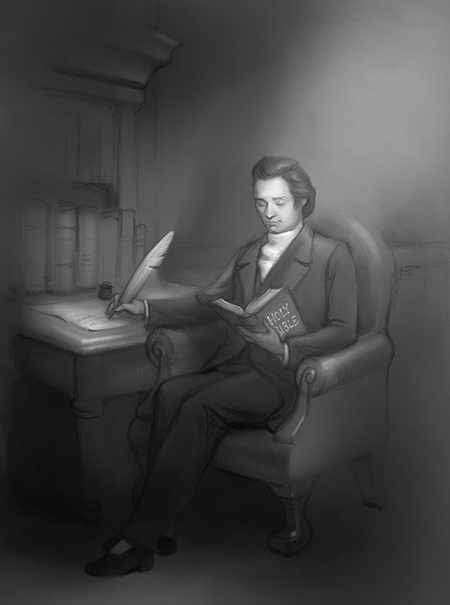
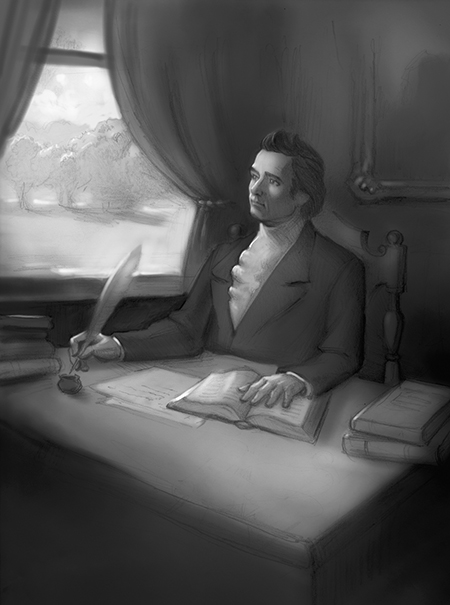
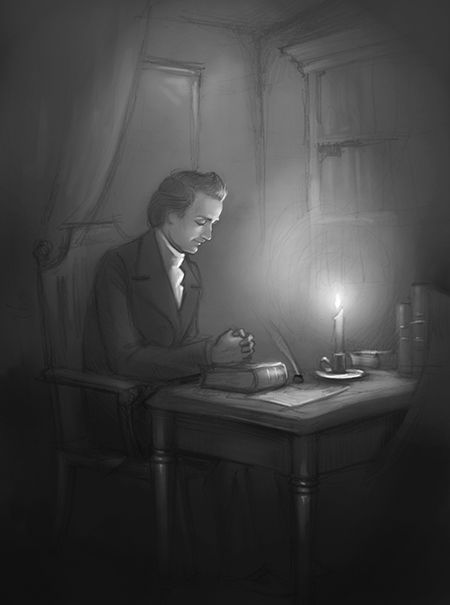
  • Below you will find three sketches from a talented artist and friend depicting Noah Webster at work. Please tell us what you think.
Divine Study
  • Divine StudyDivine Study
    Divine Study
Window of Reflection
  • Window of ReflectionWindow of Reflection
    Window of Reflection
Enlightening Grace
  • Enlightening GraceEnlightening Grace
    Enlightening Grace

160

938

114

1020

189

1056
Explicit

EXPLIC'IT, adjective [Latin explicitus, part of explico, to unfold.]

1. Literally, unfolded. Hence, plain in language; open to the understanding; clear, not obscure or ambiguous; express, not merely implied. An explicit proposition or declaration is that in which the words, in their common acceptation, express the true meaning of the person who utters them, and in which there is no ambiguity or disguise.

2. Plain; open; clear; unreserved; having no disguised meaning or reservation; applied to persons. He was explicit in his terms.

Why 1828?

Word of the Day

importance

IMPORT'ANCE, n.

1. Weight; consequence; a bearing on some interest; that quality of any thing by which it may affect a measure, interest or result. The education of youth is of great importance to a free government. A religious education is of infinite importance to every human being.

2. Weight or consequence in the scale of being.

Thy own importance know.

Nor bound thy narrow views to things below.

3. Weight or consequence in self-estimation.

He believes himself a man of importance.

4. Thing implied; matter; subject; importunity. [In these senses, obsolete.]

Random Word

blow

BLOW, n. [This probably is a contracted word, and the primary sense must be, to strike, thrust, push, or throw, that is, to drive. I have not found it in the cognate dialects. If g or other palatal letter is lost, it corresponds in elements with the L.plaga

fligo; Eng.flog.]

1. The act of striking; more generally the stroke; a violent application of the hand, fist, or an instrument to an object.

2. The fatal stroke; a stroke that kills; hence, death.

3. An act of hostility; as, the nation which strikes the first blow. Hence, to come to blows, is to engage in combat, whether by individuals, armies, fleets or nations; and when by nations, it is war.

4. A sudden calamity; a sudden or severe evil. In like manner, plaga in Latin gives rise to the Eng. plague.

5. A single act; a sudden event; as, to gain or lose a province at a blow, or by one blow.

At a stroke is used in like manner.

6. An ovum or egg deposited by a fly, on flesh or other substance, called a fly-blow.

BLOW, v.t. pret. blew; pp.blown. [L.flo, to blow. This word probably is from the same root as bloom, blossom, blow, a flower.]

1. To make a current of air; to move as air; as, the wind blows. Often used with it; as, it blows a gale.

2. To pant; to puff; to breathe hard or quick.

Here is Mrs. Page at the door, sweating and blowing.

3. To breathe; as, to blow hot and cold.

4. To sound with being blown, as a horn or trumpet.

5. To flower; to blossom; to bloom; as plants.

How blows the citron grove.

To blow over, to pass away without effect;to cease or be dissipated; as, the storm or the clouds are blown over.

To blow up, to rise in the air; also, to be broken and scattered by the explosion of gunpowder.

BLOW, v.t. To throw or drive a current of air upon; as, to blow the fire; also, to fan.

1. To drive by a current of air; to impel; as, the tempest blew the ship ashore.

2. To breathe upon, for the purpose of warming; as, to blow the fingers in a cold day.

3. To sound a wind instrument; as, blow the trumpet.

4. To spread by report.

And through the court his courtesy was blown.

5. To deposit eggs, as flies.

6. To form bubbles by blowing.

7. To swell and inflate, as veal; a practice of butchers.

8. To form glass into a particular shape by the breath, as in glass manufactories.

9. To melt tin, after being first burnt to destroy the mundic.

To blow away, to dissipate; to scatter with wind.

To blow down, to prostrate by wind.

To blow off, to shave down by wind, as to blow off fruit from trees; to drive from land, as to blow off a ship.

To blow out, to extinguish by a current of air, as a candle.

To blow up,to fill with air; to swell; as, to blow up a bladder or a bubble.

10. To inflate; to puff up; as, to blow up one with flattery.

11. To kindle; as, to blow up a contention.

12. To burst, to raise into the air,or to scatter, by the explosion of gunpowder. Figuratively, to scatter or bring to naught suddenly; as, to blow up a scheme.

To blow upon, to make stale; as, to blow upon an author's works.

BLOW, n. A flower; a blossom. This word is in general use in the U. States, and legitimate. In the Tatler, it is used for blossoms in general, as we use blowth.

1. Among seamen, a gale of wind. This also is a legitimate word, in general use in the U. States.

Noah's 1828 Dictionary

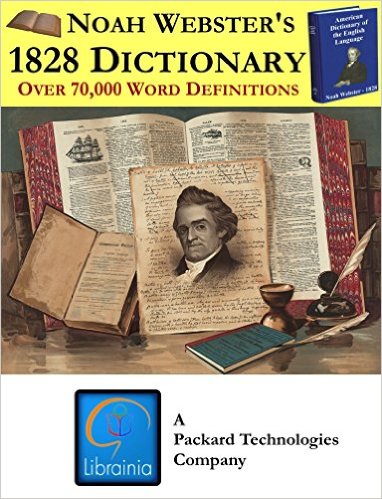
First dictionary of the American Language!

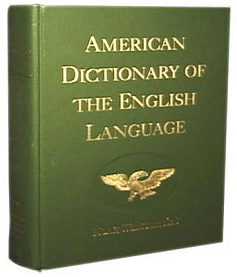
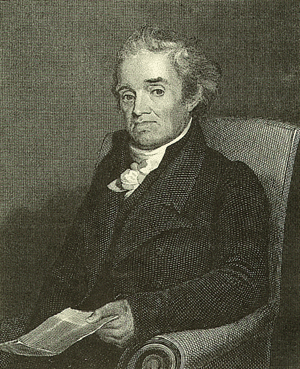
Noah Webster, the Father of American Christian education, wrote the first American dictionary and established a system of rules to govern spelling, grammar, and reading. This master linguist understood the power of words, their definitions, and the need for precise word usage in communication to maintain independence. Webster used the Bible as the foundation for his definitions.

This standard reference tool will greatly assist students of all ages in their studies.

No other dictionary compares with the Webster's 1828 dictionary. The English language has changed again and again and in many instances has become corrupt. The American Dictionary of the English Language is based upon God's written word, for Noah Webster used the Bible as the foundation for his definitions. This standard reference tool will greatly assist students of all ages in their studies. From American History to literature, from science to the Word of God, this dictionary is a necessity. For homeschoolers as well as avid Bible students it is easy, fast, and sophisticated.


Regards,


monte

{x:

Project:: 1828 Reprint


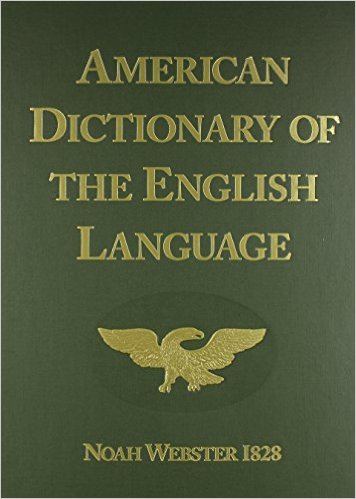
Hard-cover Edition

370

548

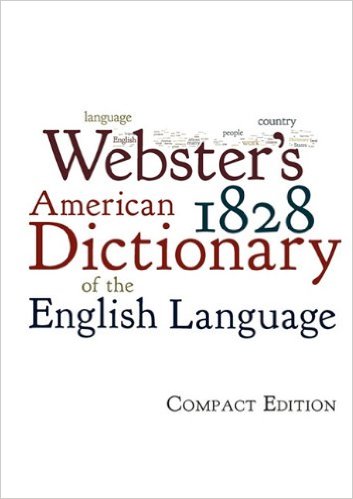
Compact Edition

355

246

CD-ROM

305

193

* As a note, I have purchased each of these products. In fact, as we have been developing the Project:: 1828 Reprint, I have purchased several of the bulky hard-cover dictionaries. My opinion is that the 2000-page hard-cover edition is the only good viable solution at this time. The compact edition was a bit disappointing and the CD-ROM as well.


[ + ]
Add Search To Your Site


Our goal is to convert the facsimile dictionary (PDF available: v1 and v2) to reprint it and make it digitally available in several formats.

Overview of Project

  1. Image dissection
  2. Text Emulation
  3. Dictionary Formatting
  4. Digital Applications
  5. Reprint

Please visit our friends:

{ourFriends}

Learn more about U.S. patents:

{ourPatent}

Privacy Policy

We want to provide the best 1828 dictionary service to you. As such, we collect data, allow you to login, and we want your feedback on other features you would like.

For details of our terms of use, please read our privacy policy here.

Page loaded in 1.021 seconds. [1828: 22, T:0]


1828 Noah Webster Dictionary

^ return to top
Back to Top