|
Search, browse, and study this dictionary to learn more about the early American, Christian language. 
1828.mshaffer.com › Word [consent]
CONSENT, n. [L., to be of one mind, to agree; to think, feel or perceive. See Sense and Assent.] 1. Agreement of the mind to what is proposed or state by another; accord; hence, a yielding of the mind or will to that which is proposed; as, a parent gives his consent to the marriage of his daughter. We generally use this word in cases where power, rights, and claims are concerned. We give consent, when we yield that which we have a right to withhold; but we do not give consent to a mere opinion, or abstract proposition. In this case, we give our assent. But assent is also used in conceding what we may withhold. We give our assent to the marriage of a daughter. Consequently, assent has a more extensive application than consent. But the distinction is not always observed. Consent often amounts to permission.Defraud ye not one another, except with consent for a time. 1 Corinthians 7.2. Accord of minds; agreement; unity of opinion.All with one consent began to make excuse. Luke 14.The company of priests murder by consent. Hosea. 6.3. Agreement; coherence; correspondence in parts, qualities, or operation.Such is the worlds great harmony that springs from union, order, full consent of things.4. In the animal economy, an agreement, or sympathy, by which one affected part of the system affects some distant part. This consent is supposed to exist in, or be produced by the nerves; and the affections to be communicated from one part to another by means of their ramifications and distribution through the body. Thus, the stone in the bladder, by vellicating the fibers, will produce spasms and colic in the bowels; a shameful thing seen or heard will produce blushing in the cheeks. But many facts indicate that other causes than nervous communication produce sympathy.CONSENT, v.i. [L. See the Noun.] 1. Literally, to think with another. Hence, to agree or accord. More generally, to agree in mind and will; to yield to what one has the power, the right, or the disposition to withhold, or refuse to grant.If sinners entice thee, consent thou not. Proverbs 1.And Saul was consenting to Stephens death. Acts 8.Only let us consent to them, and they will dwell with us. Genesis 34.2. To agree.When thou sawest a thief, thou consentedst with him. Psalm 1.3. To assent.I consent to the law that it is good. Romans 7. 1 Timothy 6.
|
Evolution (or devolution) of this word [consent]
| 1828 Webster | 1844 Webster | 1913 Webster |
|---|
CONSENT, n. [L., to be of one mind, to agree; to think, feel or perceive. See Sense and Assent.] 1. Agreement of the mind to what is proposed or state by another; accord; hence, a yielding of the mind or will to that which is proposed; as, a parent gives his consent to the marriage of his daughter. We generally use this word in cases where power, rights, and claims are concerned. We give consent, when we yield that which we have a right to withhold; but we do not give consent to a mere opinion, or abstract proposition. In this case, we give our assent. But assent is also used in conceding what we may withhold. We give our assent to the marriage of a daughter. Consequently, assent has a more extensive application than consent. But the distinction is not always observed. Consent often amounts to permission.Defraud ye not one another, except with consent for a time. 1 Corinthians 7.2. Accord of minds; agreement; unity of opinion.All with one consent began to make excuse. Luke 14.The company of priests murder by consent. Hosea. 6.3. Agreement; coherence; correspondence in parts, qualities, or operation.Such is the worlds great harmony that springs from union, order, full consent of things.4. In the animal economy, an agreement, or sympathy, by which one affected part of the system affects some distant part. This consent is supposed to exist in, or be produced by the nerves; and the affections to be communicated from one part to another by means of their ramifications and distribution through the body. Thus, the stone in the bladder, by vellicating the fibers, will produce spasms and colic in the bowels; a shameful thing seen or heard will produce blushing in the cheeks. But many facts indicate that other causes than nervous communication produce sympathy.CONSENT, v.i. [L. See the Noun.] 1. Literally, to think with another. Hence, to agree or accord. More generally, to agree in mind and will; to yield to what one has the power, the right, or the disposition to withhold, or refuse to grant.If sinners entice thee, consent thou not. Proverbs 1.And Saul was consenting to Stephens death. Acts 8.Only let us consent to them, and they will dwell with us. Genesis 34.2. To agree.When thou sawest a thief, thou consentedst with him. Psalm 1.3. To assent.I consent to the law that it is good. Romans 7. 1 Timothy 6. |
CON-SENT', n. [L. consensus; It. consenso; Fr. consentement; consentimiento; from L. consentio, to be of one mind, to agree; con and sentio, to think, feel, or perceive; Sp. consentir; Port. Fr. id.; It. consentire. See Sense and Assent.]- Agreement of the mind to what is proposed or stated by another; accord; hence, a yielding of the mind or will to that which is proposed; as, a parent gives his consent to the marriage of his daughter.
We generally use this word in cases where power, rights, and claims are concerned. We give consent, when we yield that which we have a right to withhold; but we do not give consent to a mere opinion, or abstract proposition. In this case, we give our assent. But assent is also used in conceding what we may withhold. We give our assent to the marriage of a daughter. Consequently, assent has a more extensive application than consent. But the distinction is not always observed. Consent often amounts to permission.
Defraud ye not one another, except with consent for a time. – 1 Cor. vii.
- Accord of minds; agreement; unity of opinion.
All with one consent began to make excuse. – Luke xiv.
The company of priests murder by consent. – Hos. vi.
- Agreement; coherence; correspondence in parts, qualities, or operation.
Such is the world's great harmony that springs / From union, order, full consent of things. – Pope.
- In the animal economy, an agreement, or sympathy, by which one affected part of the system affects some distant part. This consent is supposed to exist in, or be produced by the nerves; and the affections to be communicated from one part to another by means of their ramifications and distributions through the body. Thus, the stone in the bladder, by vellicating the fibers, will produce spasms and colic in the bowels; a shameful thing seen or heard will produce blushing in the cheeks. – Quincy. Encyc.
But many facts indicate that other causes than nervous communication produce sympathy.
CON-SENT', v.i. [L. consentio. See the Noun.]- Literally, to think with another. Hence, to agree or accord. More generally, to agree in mind and will; to yield to what one has the power, the right, or the disposition to withhold, or refuse to grant.
If sinners entice thee, consent thou not. – Prov. i.
And Saul was consenting to Stephen's death. – Acts viii.
Only let us consent to them, and they will dwell with us. – Gen. xxxiv.
- To agree.
When thou sawest a thief, thou consentedst with him. – Ps. l.
- To assent.
I consent to the law that it is good. – Rom. vii. 1 Tim. vi.
|
Con*sent"
- To agree in opinion or sentiment; to be
of the same mind; to accord; to concur.
- To grant; to
allow; to assent to; to admit.
- Agreement in opinion or
sentiment; the being of one mind; accord.
- To indicate or express a willingness;
to yield to guidance, persuasion, or necessity; to give assent or
approval; to comply.
- Correspondence in parts, qualities, or
operations; agreement; harmony; coherence.
- Voluntary accordance with, or
concurrence in, what is done or proposed by another;
acquiescence; compliance; approval; permission.
- Capable, deliberate, and
voluntary assent or agreement to, or concurrence in, some act or
purpose, implying physical and mental power and free
action.
- Sympathy. See
Sympathy, 4.
|
| 1828 Webster | 1844 Webster | 1913 Webster |
|---|
Thank you for visiting!
- Our goal is to try and improve the quality of the digital form of this dictionary being historically true and accurate to the first American dictionary. Read more ...
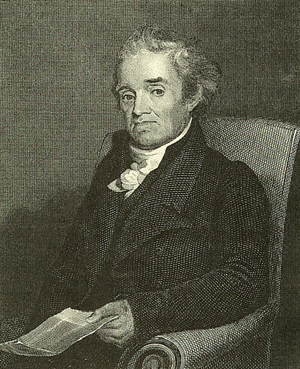
- Below you will find three sketches from a talented artist and friend depicting Noah Webster at work. Please tell us what you think.
Divine Study
 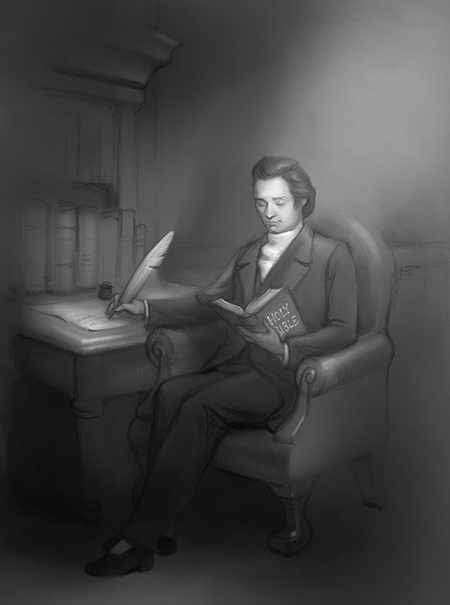
Divine Study
|
Window of Reflection
 
Window of Reflection
|
Enlightening Grace
 
Enlightening Grace
|
164
|
953 |
126
|
1036 |
199
|
1076 |

Consent CONSENT, noun [Latin , to be of one mind, to agree; to think, feel or perceive. See Sense and Assent.] 1. Agreement of the mind to what is proposed or state by another; accord; hence, a yielding of the mind or will to that which is proposed; as, a parent gives his consent to the marriage of his daughter. We generally use this word in cases where power, rights, and claims are concerned. We give consent when we yield that which we have a right to withhold; but we do not give consent to a mere opinion, or abstract proposition. In this case, we give our assent. But assent is also used in conceding what we may withhold. We give our assent to the marriage of a daughter. Consequently, assent has a more extensive application than consent But the distinction is not always observed. consent often amounts to permission. Defraud ye not one another, except with consent for a time. 1 Corinthians 7:5. 2. Accord of minds; agreement; unity of opinion. All with one consent began to make excuse. Luke 14:18. The company of priests murder by consent Hosea 6. 3. Agreement; coherence; correspondence in parts, qualities, or operation. Such is the worlds great harmony that springs from union, order, full consent of things. 4. In the animal economy, an agreement, or sympathy, by which one affected part of the system affects some distant part. This consent is supposed to exist in, or be produced by the nerves; and the affections to be communicated from one part to another by means of their ramifications and distribution through the body. Thus, the stone in the bladder, by vellicating the fibers, will produce spasms and colic in the bowels; a shameful thing seen or heard will produce blushing in the cheeks. But many facts indicate that other causes than nervous communication produce sympathy. CONSENT, verb intransitive [Latin See the Noun.] 1. Literally, to think with another. Hence, to agree or accord. More generally, to agree in mind and will; to yield to what one has the power, the right, or the disposition to withhold, or refuse to grant. If sinners entice thee, consent thou not. Proverbs 1:10. And Saul was consenting to Stephens death. Acts 8:1. Only let us consent to them, and they will dwell with us. Genesis 34:15. 2. To agree. When thou sawest a thief, thou consentedst with him. Psalms 1:1. 3. To assent. I consent to the law that it is good. Romans 7:16. 1 Timothy 6:3. |

|
| Hard-cover Edition |
383 |
 |
564 |
|
| Compact Edition |
369 |
 |
257 |
|
| CD-ROM |
325 |
 |
202 |
|
* As a note, I have purchased each of these products. In fact, as we have been developing the Project:: 1828 Reprint, I have purchased several of the bulky hard-cover dictionaries. My opinion is that the 2000-page hard-cover edition is the only good viable solution at this time. The compact edition was a bit disappointing and the CD-ROM as well. |
| [ + ] |
| Add Search To Your Site |
|
|
|