|
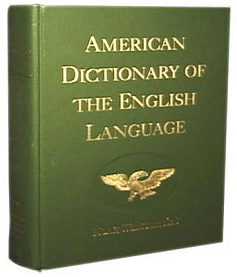
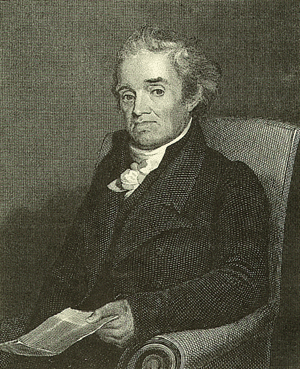
Search, browse, and study this dictionary to learn more about the early American, Christian language. 
1828.mshaffer.com › Word [arsenic]
'ARSENIC, n. [Gr.'L. arsenicum.] Arsenic, as it is usually seen in the shops, is not a metal, but an oxyd, from which the metal may be easily obtained by mixing it with half its weight of black flux, and introducing the mixture into a Florence flask, gradually raised to a red heat, in a sand bath. A brilliant metallic sublimate of pure arsenic collects in the upper part of the flask. Arsenic is of a steel blue color, quite brittle, and the metal with all its compounds, is a virulent poison, vulgarly called rats-bane. It forms alloys with most of the metals. Combined with sulphur it forms orpiment or realgar, which are the yellow and red sulphurets of arsenic. Orpiment is the true arsenicum of the ancients. Plin. 34, 18. native orpiment appears in yellow, brilliant, and seemingly talcky masses of various sizes; realgar is red, of different shades, and often crystallized in needles. Arsenic is also found as a mineralizer in cobalt, antimony, copper, iron and silver ores. It is brought chiefly from the cobalt works in Saxony, where zaffer is made.
|
Evolution (or devolution) of this word [arsenic]
| 1828 Webster | 1844 Webster | 1913 Webster |
|---|
'ARSENIC, n. [Gr.'L. arsenicum.] Arsenic, as it is usually seen in the shops, is not a metal, but an oxyd, from which the metal may be easily obtained by mixing it with half its weight of black flux, and introducing the mixture into a Florence flask, gradually raised to a red heat, in a sand bath. A brilliant metallic sublimate of pure arsenic collects in the upper part of the flask. Arsenic is of a steel blue color, quite brittle, and the metal with all its compounds, is a virulent poison, vulgarly called rats-bane. It forms alloys with most of the metals. Combined with sulphur it forms orpiment or realgar, which are the yellow and red sulphurets of arsenic. Orpiment is the true arsenicum of the ancients. Plin. 34, 18. native orpiment appears in yellow, brilliant, and seemingly talcky masses of various sizes; realgar is red, of different shades, and often crystallized in needles. Arsenic is also found as a mineralizer in cobalt, antimony, copper, iron and silver ores. It is brought chiefly from the cobalt works in Saxony, where zaffer is made. |
AR'SEN-IC, n. [Ar. زِرْنَقٌ zirnakon; Syr. ܐܪܢܝܒܐ zarnika; Gr. αρσενικον; L. arsenicum; Sp. arsenico; Fr. arsenic.]Arsenic, as it is usually seen in the shops, is not a metal, but an acid from which the metal may be easily obtained by mixing it with half its weight of black flux, and introducing the mixture into a Florence flask, gradually raised to a red heat, in a sand bath. A brilliant metallic sublimate of pure arsenic collects in the upper part of the flask. Arsenic is of a steel blue color, quite brittle. It forms alloys with most of the metals. Combined with sulphur it forms orpiment or realgar, which are the yellow and red sulphurets of arsenic. Orpiment is the true arsenicum of the ancients. Plin. 34, 18. Native orpiment appears in yellow, brilliant, and seemingly talcky masses of various sizes; realgar is red, of different shades, and often crystalized in needles. Arsenic is also found as a mineralizer in cobalt, antimony, copper, iron and silver ores. It is brought chiefly from the cobalt works in Saxony, where zaffer is made. – Fourcroy. Nicholson. Cyc. |
Ar"se*nic
- One of the
elements, a solid substance resembling a metal in its physical properties,
but in its chemical relations ranking with the nonmetals. It is of a steel-
gray color and brilliant luster, though usually dull from tarnish. It is
very brittle, and sublimes at 356° Fahrenheit. It is sometimes found
native, but usually combined with silver, cobalt, nickel, iron, antimony,
or sulphur. Orpiment and realgar are two of its sulphur compounds, the
first of which is the true arsenicum of the ancients. The element
and its compounds are active poisons. Specific gravity from 5.7 to 5.9.
Atomic weight 75. Symbol As.
- Pertaining
to, or derived from, arsenic; -- said of those compounds of arsenic in
which this element has its highest equivalence; as, arsenic
acid.
- Arsenious oxide or arsenious
anhydride; -- called also arsenious acid, white arsenic, and
ratsbane.
|
| 1828 Webster | 1844 Webster | 1913 Webster |
|---|
Thank you for visiting!
- Our goal is to try and improve the quality of the digital form of this dictionary being historically true and accurate to the first American dictionary. Read more ...
- Below you will find three sketches from a talented artist and friend depicting Noah Webster at work. Please tell us what you think.
Divine Study
 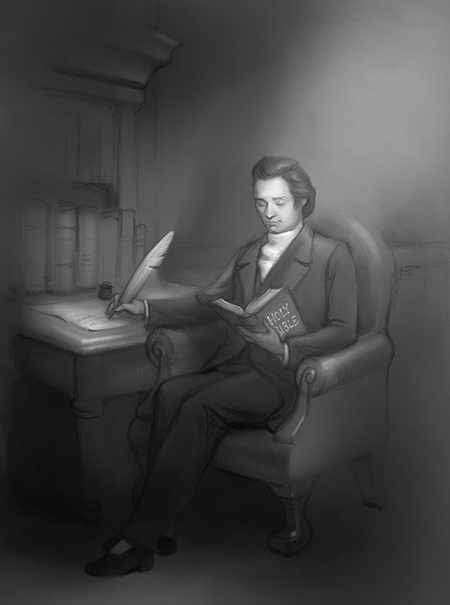
Divine Study
|
Window of Reflection
 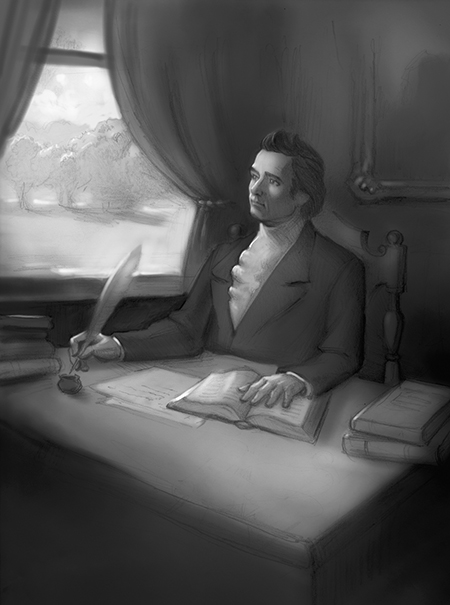
Window of Reflection
|
Enlightening Grace
 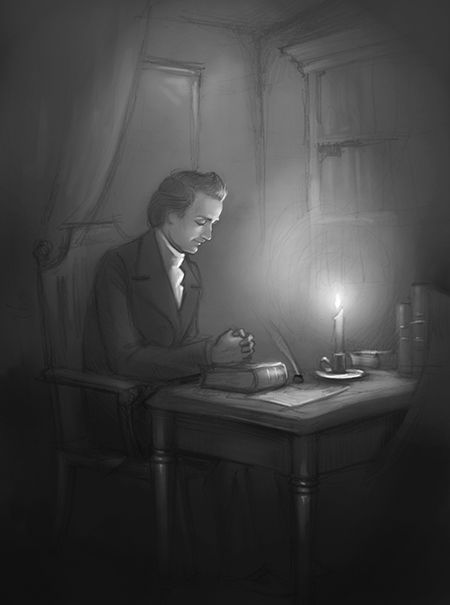
Enlightening Grace
|
164
|
949 |
125
|
1032 |
199
|
1069 |

Arsenic 'ARSENIC, noun [Gr.'L. arsenicum.] Arsenic, as it is usually seen in the shops, is not a metal, but an oxyd, from which the metal may be easily obtained by mixing it with half its weight of black flux, and introducing the mixture into a Florence flask, gradually raised to a red heat, in a sand bath. A brilliant metallic sublimate of pure arsenic collects in the upper part of the flask. arsenic is of a steel blue color, quite brittle, and the metal with all its compounds, is a virulent poison, vulgarly called rats-bane. It forms alloys with most of the metals. Combined with sulphur it forms orpiment or realgar, which are the yellow and red sulphurets of arsenic Orpiment is the true arsenicum of the ancients. Plin. 34, 18. native orpiment appears in yellow, brilliant, and seemingly talcky masses of various sizes; realgar is red, of different shades, and often crystallized in needles. arsenic is also found as a mineralizer in cobalt, antimony, copper, iron and silver ores. It is brought chiefly from the cobalt works in Saxony, where zaffer is made. |

|
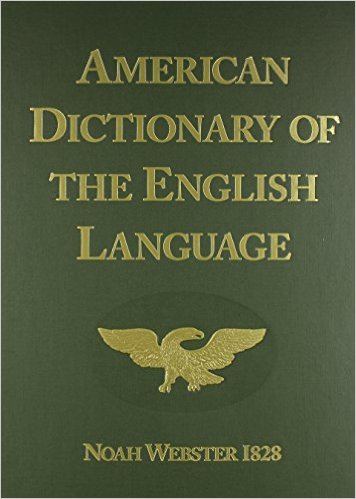
| Hard-cover Edition |
382 |
 |
561 |
|
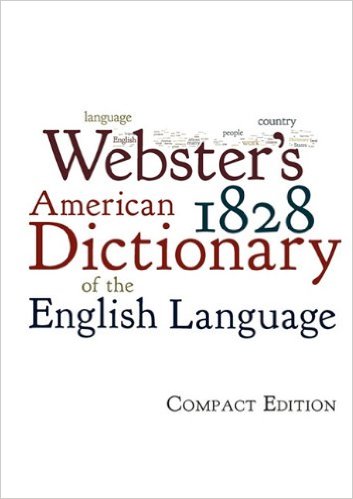
| Compact Edition |
366 |
 |
255 |
|
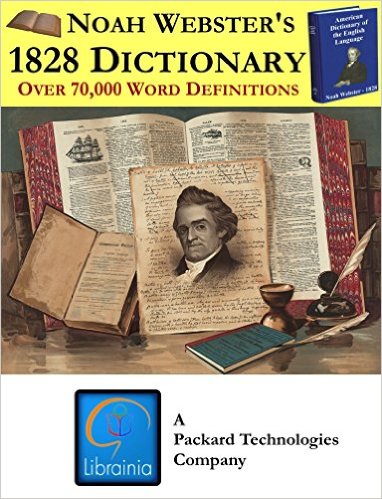
| CD-ROM |
322 |
 |
200 |
|
* As a note, I have purchased each of these products. In fact, as we have been developing the Project:: 1828 Reprint, I have purchased several of the bulky hard-cover dictionaries. My opinion is that the 2000-page hard-cover edition is the only good viable solution at this time. The compact edition was a bit disappointing and the CD-ROM as well. |
| [ + ] |
| Add Search To Your Site |
|
|
|