Free Online Color Picker Harmony Tool! http://1828.mshaffer.com
Monday - February 6, 2012

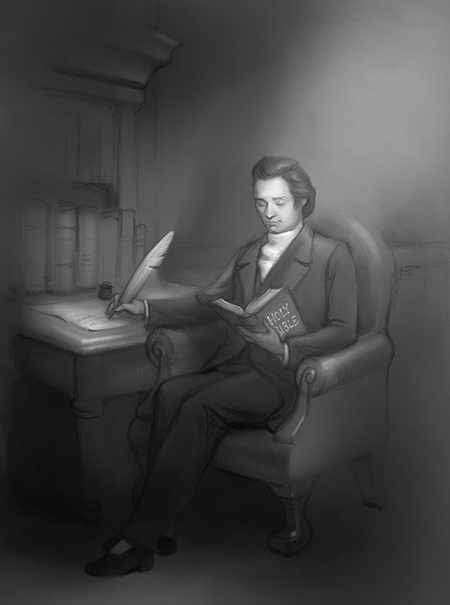
In my view, the Christian religion is the most important and one of the first things in which all children, under a free government ought to be instructed.. .No truth is more evident to my mind than that the Christian religion must be the basis of any government intended to secure the rights and privileges of a free people.
- Preface

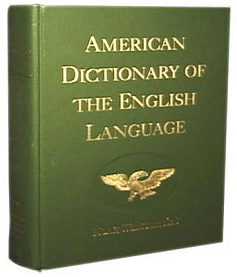
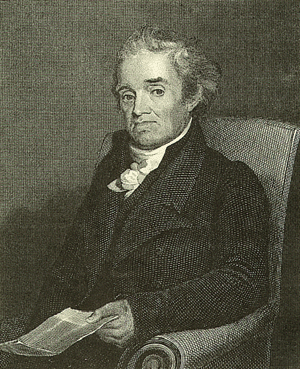
1828 Noah Webster Dictionary
ABCDEFGHIJKLMNOPQRSTUVWXYZ
In celebration of Noah Webster's Birthday (October 16, 2009), we have prepared an updated website.
Please update your bookmarks: http://www.1828-dictionary.com/d/search/word,fail

Your search [word => 'fail' ] returned 4 results.

fail

FAIL, v.i. [L. fallo; Gr. whence; Eng. felony. It seems to be allied to fall, fallow, pale, and many other words.]

1. To become deficient; to be insufficient; to cease to be abundant for supply; or to be entirely wanting. We say, in a dry season, the springs and streams fail, or are failing, before they are entirely exhausted. We say also, the springs failed, when they entirely ceased to flow. Crops fail wholly or partially.

2. To decay; to decline; to sink; to be diminished. We say of a sick person, his strength fails daily.

3. To decline; to decay; to sink; to become weaker; as, the patient fails every hour.

4. To be extinct; to cease; to be entirely wanting; to be no longer produced.

Help, Lord, for the godly man ceaseth; for the faithful fail from among the children of men. Ps. 12.

5. To be entirely exhausted; to be wanting; to cease from supply.

Money failed in the land of Egypt. Gen. 47.

6. To cease; to perish; to be lost.

Lest the remembrance of his grief should fail.

7. To die.

They shall all fail together. Isaiah 31.

8. To decay; to decline; as, the sight fails in old age.

9. To become deficient or wanting; as, the heart or the courage fails.

10. To miss; not to produce the effect. the experiment was made with care, but failed, or failed to produce the effect, or failed of the effect.

11. To be deficient in duty; to omit or neglect. the debtor failed to fulfil his promise.

12. To miss; to miscarry; to be frustrated or disappointed. The enemy attacked the fort, but failed in his design, or failed of success.

13. To be neglected; to fall short; not to be executed. the promises of a man of probity seldom fail.

The soul or the spirit fails, when a person is discouraged. The eyes fail, when the desires and expectations are long delayed, and the person is disappointed.

14. To become insolvent or bankrupt. When merchants and traders fail, they are said to become bankrupt. When other men fail, they are said to become insolvent.

FAIL, v.t.

1. To desert; to disappoint; to cease or to neglect or omit to afford aid, supply or strength. it is said, fortune never fails the brave. Our friends sometimes fail us, when we most need them. The aged attempt to walk, when their limbs fail them. In bold enterprises, courage should never fail the hero.

2. to omit; not to perform.

The inventive God, who never fails his part.

3. to be wanting to.

There shall never fail thee a man on the throne. 1Kings 2.

[In the transitive use of this verb there is really an ellipsis of from or to, or other word. In strictness, the verb is not transitive, and the passive particple is, I believe, never used.]

FAIL, n. Omission; non-performance.

1. He will without fail drive out from before you the Canaanites. Josh. 3.

2. Miscarriage; failure; deficience; want; death.

[In these senses little used.]

failance

FA'ILANCE, n. fault; failure. Obs.


failing

FA'ILING, ppr. Becoming deficient or insufficient; becoming weaker; decaying; declining; omitting; not executing or performing; miscarrying; neglecting; wanting; becoming bankrupt or insolvent.

FA'ILING, n.

1. The act of failing; deficiency; imperfection; lapse; fault. Failings, in a moral sense, are minor faults, proceeding rather from weakness of intellect or from carelessness, than from bad motives. But the word is often abusively applied to vices of a grosser kind.

2. The act of failing or becoming insolvent.

failure

FA'ILURE, n. fa'ilyur.

1. A failing; deficience; cessation of supply, or total defect; as the failure of springs or streams; failure of rain; failure of crops.

2. Omission; non-performance; as the failure of a promise; a man's failure in the execution of a trust.

3. Decay, or defect from decay; as the failure of memory or of sight.

4. A breaking, or becoming insolvent. At the close of a war, the prices of commodities fall, and innumerable failures secceed.

5. A failing; a slight fault. [Little used.]


1828 Noah Webster Dictionary

Google
 
Web 1828.mshaffer.com

Why Donate?

Here are a number of reasons:

  • To indicate your approval.
  • To express your appreciation.
  • To help pay for website expenses and keep this website online.

Donate Using PayPal

If you have a major credit card (Visa, MasterCard, American Express) or a PayPal account, donating is easy. Just click the dollar amount below to donate:

Make payments with PayPal - it's fast, free and secure!
$ 5 $ 10 $ 20 $ 50 $ 100 $ Other $
 

Donations from Outside of the United States

We welcome donations from anywhere in the world and in any currency. PayPal accepts a number of international currencies.

Donations by Other Methods

If you wish to donate via direct bank deposit or mail a cheque or money order, please email me .


Please support this FREE service, by making a donation today!

Firefox Plugin
I | S 1828 Webster's 1828 Webster's


Add Search
To Your Site
[ + ]

News: council

February 06, 2012
[12:04:56 AM] (PDT)


Our partners included enterprise partners, ranging from Fortune 100 companies to small companies. Among our enterprise partners are US and international businesses. We've also received input from research organizations and tech transfer operations. We've sought and received feedback from inventors, a group we believe are the heroes of the knowledge economy. Friends in the IP profession were given opportunities to use and provide feedback. We also engaged investors, venture capitalists, private equity, analysts and others in the financial world to hear what types of tools would make a difference to them when analyzing companies or IP assets. This robust representation has led to better designs. Our development team built tools with these varied personas in mind, so that the suite would assist not only the largest of IP holders, but would be relevant and immediately useable by SMEs, individual inventors, and business professionals. We are confident that you will find these tools valuable for your endeavors.
You need IP intelligence to meet corporate objectives related to your business function. If you are a HR director, you can utilize TalentScout™ to identify the inventors that are essential to corporate success. If you are an IP portfolio manager, you can utilize our tools to identify the IP landscape. If you are a licensing executive, you can utilize our tools to identify potential inbound and outbound relationships. IP Street will assist you in better understanding patent duration and patent analytics.
Here are five common factors that often determine the worth of an invention. (1) Importance of a Patent: For breakthrough patents, a.k.a. foundational patents, the patents are so innovative that they give the owner a complete monopoly over an entire industry and are extremely valuable, often worth billions of dollars. Although most patents never reach these heady heights they are nevertheless valuable in that they can force a competitor to start innovating to keep pace with new and improved technologies and products in the market. Incremental patents, which make only small advances over existing products, are usually the least valuable though this may not be always so. A question that is often asked in relation to endeavoring to put a price on a patent is 'How much would my competitors pay to use my protected product or process?' (2) The Market: Market size, the number of products that are likely to be made and the cost of each product also have a significant bearing on the value of a patent. What sort of sales can the patent be expected to support, and for how long? A good example of an article which has significant market presence is the ubiquitous Intel chip that is reported to have a value estimated in the billions of dollars. (3) The Patent Term: Patents have a maximum life of 20 years and, therefore, a 20-year potential monopoly. Patents that are just beginning their life and which have longer to run on the their potential monopoly position understandably will have more value. It is rare that a patent nearing the end of its term will cause a great threat to its competitors. It is almost certain that they will have devised technologies or products of their own by then that will not interfere with the patent owners monopoly position. In addition, one has to take into consideration the potential business life of a patent, i.e., the duration, which a patent is likely to be economically useful, if other subsequent patents are providing better alternatives to it. (4) Amount of Prior Art: The number of cited documents or patented products populating an area of innovation also has an effect on the value of a patent. Generally, if the particular product is one of many products of a similar type then the consumers' options de-value the patent of interest, yielding a relatively smaller premium than, for example, a stand alone patent with a captured customer base and no adjacent competition. (5) Patent Significance: Every patent has its own significance in a particular area and will usually form part of an overall IP strategy either to maximize its earning potential or to allow other patents to maximize theirs. Examples of such patents are those that are used to block other key players from gaining a foothold in a market. Yet other examples are those patents that are additional to an original patent and rely on the protected matter in the original patent to successfully operate. It is not uncommon for drug companies or telecom companies to take out further patents protecting a strong first generation of patents, thus securing a big chunk of a market and the ability to negotiate licenses and royalties from the protected, but much desired technology.
0.031650066375732|February 6, 2012 => 11:24 pm